The entertainment and digital media industries have expanded beyond traditional filmmaking. Today, animation, motion graphics, visual effects, video content and digital filmmaking are used across films, advertisements, social media, gaming, education and online platforms.
For students and aspiring creative professionals, choosing a Multimedia Animation and Digital Filmmaking Institute in Ahmedabad can provide structured training in creative software, animation techniques, video production and practical projects.
A well-designed course can help learners understand the complete creative workflow, from developing an idea and creating visual assets to producing and editing the final video.
This guide explores Multimedia Animation and Digital Filmmaking courses, syllabus, fees, tools, practical training and career opportunities in Ahmedabad.
What Is Multimedia Animation?
Multimedia Animation combines different forms of digital media, including:
- Graphics
- Animation
- Video
- Audio
- Motion graphics
- Visual effects
- Interactive content
Animation can be used to communicate stories, concepts, advertisements, educational information and entertainment.
Depending on the specialization, students may learn 2D animation, 3D animation, motion graphics, character animation and other digital production techniques.
What Is Digital Filmmaking?
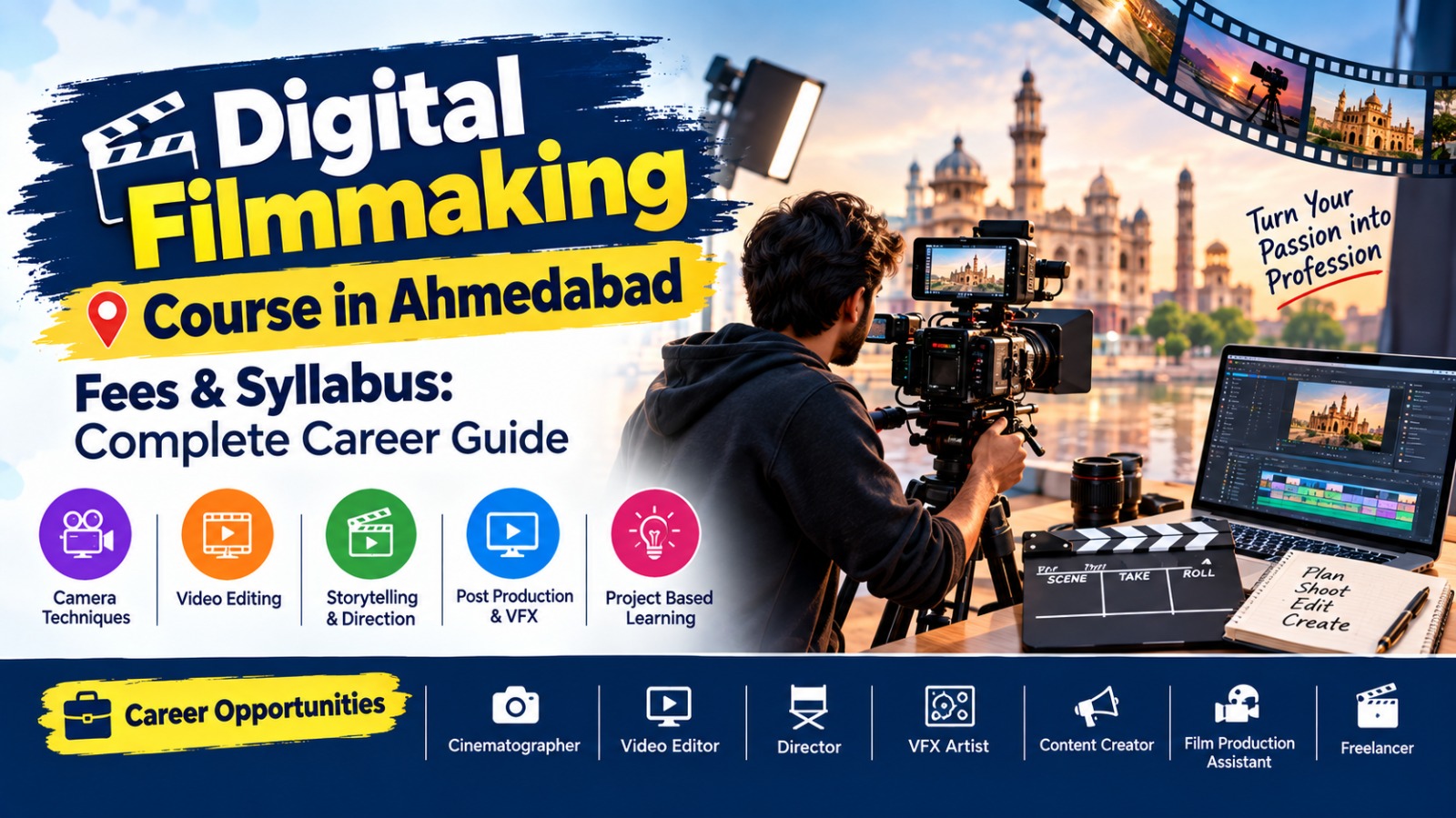
Digital Filmmaking involves creating video and film content using modern digital production techniques.
The process can include:
Idea → Script → Pre-Production → Shooting → Editing → Sound → Colour → Final Production
Students can learn how different stages of production work together to create a finished video.
Digital filmmaking can be applied to:
- Short films
- Advertisements
- Music videos
- Documentaries
- Corporate videos
- Social media videos
- YouTube content
- Digital campaigns
Why Choose Multimedia Animation and Digital Filmmaking in Ahmedabad?
Ahmedabad has a growing creative, advertising, digital marketing and media ecosystem.
Businesses increasingly use video and visual content for:
- Advertising
- Social media
- Brand communication
- Product promotion
- Digital campaigns
- Educational content
- Entertainment
Learning animation and filmmaking can help students develop skills relevant to multiple creative industries.
A structured institute can also provide:
- Classroom or online training
- Practical assignments
- Software training
- Project-based learning
- Trainer feedback
- Portfolio development
- Career guidance
Multimedia Animation Course Syllabus
The exact syllabus depends on the institute and course level, but a comprehensive program may include the following.
1. Fundamentals of Design
Students first develop an understanding of:
- Design principles
- Colour theory
- Typography
- Composition
- Visual hierarchy
- Storytelling
These fundamentals support later animation and filmmaking work.
2. 2D Animation
Students can learn how to create animated graphics and illustrations.
Topics may include:
- Basic animation principles
- Character movement
- Keyframes
- Timing
- Transitions
- Scene creation
- 2D motion
3. 3D Animation
3D animation involves creating and animating objects and environments in three-dimensional space.
Students may explore:
- 3D modelling
- Texturing
- Lighting
- Rigging
- Animation
- Rendering
4. Motion Graphics
Motion graphics combine graphic design and animation to create moving visual content.
Projects may include:
- Title animations
- Promotional videos
- Logo animation
- Social media videos
- Explainer videos
- Advertisement graphics
5. Visual Effects
VFX combines filmed footage with digital elements to create visual effects that may be difficult or impossible to capture directly with a camera.
Students may learn concepts such as:
- Compositing
- Green screen
- Masking
- Tracking
- Rotoscoping
- Visual effects
Digital Filmmaking Course Syllabus
A Digital Filmmaking course can cover different stages of video production.
Pre-Production
Students may learn:
- Idea development
- Storytelling
- Scriptwriting
- Storyboarding
- Shot planning
- Production planning
Production
Production training can include:
- Camera basics
- Shot composition
- Framing
- Camera movements
- Lighting
- Audio recording
- Direction
Post-Production
Students can learn:
- Video editing
- Sound editing
- Colour correction
- Colour grading
- Visual effects
- Titles
- Transitions
- Final export
Video Editing Training
Video editing is an important part of digital filmmaking and online content creation.
Students may learn how to:
- Organize footage
- Create timelines
- Cut and trim clips
- Add transitions
- Synchronize audio
- Add titles
- Apply visual effects
- Correct colours
- Export videos for different platforms
Practical editing projects can help students understand the complete post-production workflow.
Software Used in Multimedia Animation and Filmmaking
The software covered depends on the institute and specialization.
Common tools may include:
Adobe Photoshop
Useful for image editing and visual asset creation.
Adobe Illustrator
Useful for vector graphics, illustrations and design assets.
Adobe After Effects
Commonly used for motion graphics, compositing and visual effects.
Adobe Premiere Pro
Used for professional video editing and post-production.
Blender
Can be used for 3D modelling, animation, rendering and other 3D workflows.
Other 3D and Animation Tools
Advanced courses may introduce additional tools for modelling, texturing, rigging, animation and rendering.
Students should focus not only on software commands but also on storytelling, design principles, timing, composition and creative problem-solving.
Importance of Practical Training
Animation and filmmaking are highly practical fields. Students need opportunities to create projects rather than only study theory.
A practical course may include:
Animation Projects
- Character animation
- Logo animation
- Motion graphics
- 2D animation
- 3D scenes
Filmmaking Projects
- Short films
- Promotional videos
- Interviews
- Product videos
- Social media videos
- Documentary-style projects
Post-Production Projects
- Video editing
- Colour correction
- Sound editing
- Motion graphics
- Visual effects
These projects can become part of a student’s creative portfolio.
Building a Multimedia and Filmmaking Portfolio
A portfolio helps students demonstrate their practical skills to potential employers or clients.
It can include:
- Animation clips
- Motion graphics
- Short films
- Video edits
- VFX projects
- 3D models
- Character animation
- Promotional videos
- Storyboards
Students can also create a showreel, which is a short compilation of selected creative work.
A good showreel should highlight the learner’s strongest skills and relevant specialization.
Multimedia Animation & Digital Filmmaking Course Fees in Ahmedabad
Course fees vary between institutes and programs.
Factors that can influence the fee include:
- Course duration
- Specialization
- Number of software tools covered
- Practical projects
- Trainer experience
- Classroom or online format
- Certification
- Portfolio support
- Career guidance
Students should compare the entire curriculum and practical opportunities instead of choosing a course based only on the lowest fee.
Before enrolling, ask:
- What is the course duration?
- Which software is included?
- How many projects are included?
- Is practical training provided?
- Is a showreel developed?
- Is certification provided?
- Is career guidance available?
- Are assignments reviewed by trainers?
Who Can Join an Animation and Digital Filmmaking Course?
These courses can be suitable for learners from different backgrounds.
They may include:
- Students after 10th
- Students after 12th
- College students
- Graduates
- Creative arts students
- Graphic designers
- Video editors
- Digital marketers
- Content creators
- Freelancers
- Working professionals
- Career changers
An advanced technical background is not necessarily required to begin learning the fundamentals.
Interest in creativity, storytelling and visual communication can be useful for beginners.
Career Opportunities After Multimedia Animation & Digital Filmmaking
After developing relevant skills and a strong portfolio, learners can explore different roles.
Animation Careers
- 2D Animator
- 3D Animator
- Character Animator
- Motion Graphics Designer
- 3D Artist
- Animation Artist
Video and Filmmaking Careers
- Video Editor
- Assistant Director
- Cinematography Assistant
- Production Assistant
- Video Producer
- Content Creator
VFX Careers
- VFX Artist
- Compositor
- Rotoscopy Artist
- Motion Graphics Artist
- Visual Effects Assistant
Other Opportunities
Creative professionals may also explore:
- Advertising agencies
- Production houses
- Animation studios
- Digital marketing agencies
- Media companies
- Gaming companies
- Freelancing
- Content production
Actual opportunities depend on specialization, portfolio quality, experience, communication skills and employer requirements.
Freelancing Opportunities
Animation and filmmaking skills can also support freelance work.
Freelancers may provide services such as:
- Video editing
- Social media videos
- Motion graphics
- Logo animation
- Promotional videos
- YouTube editing
- Explainer videos
- Short-form video content
- VFX services
Successful freelancing also requires client communication, project management, deadlines and consistent quality.
How to Choose the Right Multimedia Animation Institute in Ahmedabad?
Before joining a course, consider the following factors.
1. Review the Syllabus
Make sure the curriculum matches your interests, whether that is animation, filmmaking, VFX, motion graphics or video editing.
2. Check Practical Projects
Ask what projects students complete during the course.
3. Review Student Work
Previous student projects can help you understand the practical outcomes of the training.
4. Check Software Training
Make sure the tools relevant to your chosen specialization are included.
5. Ask About Portfolio Development
Find out whether students receive guidance for building a showreel or professional portfolio.
6. Understand Certification
Check what type of certificate is provided after successful completion.
7. Explore Career Support
Ask whether the institute offers resume guidance, interview preparation, internship guidance or job assistance.
Benefits of Learning Multimedia Animation and Digital Filmmaking
Creative Expression
Learn to communicate stories and ideas through animation and video.
Technical Skills
Develop practical knowledge of design, animation, editing and production software.
Portfolio Development
Create projects that demonstrate your abilities.
Multiple Career Paths
Explore animation, VFX, motion graphics, video editing and filmmaking.
Digital Content Skills
Develop skills useful for social media, advertising and online content production.
Freelancing Opportunities
Use creative skills to work on independent projects for clients.
Frequently Asked Questions
1. Which is the best Multimedia Animation and Digital Filmmaking Institute in Ahmedabad?
The right institute depends on your goals and preferred specialization. Compare the syllabus, practical projects, software, trainers, fees, portfolio development and career support before enrolling.
2. What is taught in a Multimedia Animation course?
A Multimedia Animation course may cover design fundamentals, 2D animation, 3D animation, motion graphics, visual effects, modelling, rendering and digital production.
3. What is included in a Digital Filmmaking course?
Digital Filmmaking can include scriptwriting, storyboarding, camera techniques, lighting, sound, direction, video editing, colour correction and post-production.
4. How much does an Animation course cost in Ahmedabad?
Fees vary depending on course duration, specialization, software, projects, certification and training format.
5. Is animation suitable for beginners?
Yes. Beginners can start with design fundamentals and gradually learn animation principles, software and practical production techniques.
6. Do I need drawing skills to learn animation?
Drawing skills can be useful, particularly for certain forms of 2D and character animation, but animation also involves storytelling, timing, movement, software and technical skills.
7. Which software is used for Digital Filmmaking?
Depending on the course, students may learn video editing, motion graphics, image editing and other production tools such as Premiere Pro and After Effects.
8. Is practical training important for animation?
Yes. Practical projects allow students to apply animation principles, develop technical skills and create portfolio work.
9. What career options are available after an animation course?
Career options can include 2D animator, 3D animator, motion graphics designer, VFX artist, video editor, 3D artist and other multimedia roles.
10. Can I work as a freelancer after learning Digital Filmmaking?
Yes. Freelancers can offer video editing, motion graphics, promotional videos, social media content, YouTube editing and other creative services.
11. Is a portfolio important for animation and filmmaking careers?
Yes. A portfolio or showreel allows employers and clients to evaluate practical creative skills and previous project work.
12. Can Graphic Designers learn Animation and Digital Filmmaking?
Yes. Graphic designers already have knowledge of composition, typography, colour and visual communication. Animation and filmmaking training can help them expand into motion and video-based content.
Conclusion
Choosing a Multimedia Animation and Digital Filmmaking Institute in Ahmedabad can be an important step for students and aspiring creative professionals who want to develop skills in animation, video production, VFX, motion graphics and digital content creation.
A comprehensive course should combine creative fundamentals, software training, practical projects and portfolio development. Digital Filmmaking can further introduce learners to scripting, cinematography, production, editing, sound and post-production.
Before enrolling, compare the course syllabus, fees, duration, software, practical projects, trainer experience, certification and career support.
For aspiring professionals, consistent practice and a strong portfolio or showreel can be just as important as completing a course. Building practical skills across animation and digital filmmaking can provide a foundation for exploring opportunities in media, entertainment, advertising, digital content and creative production.