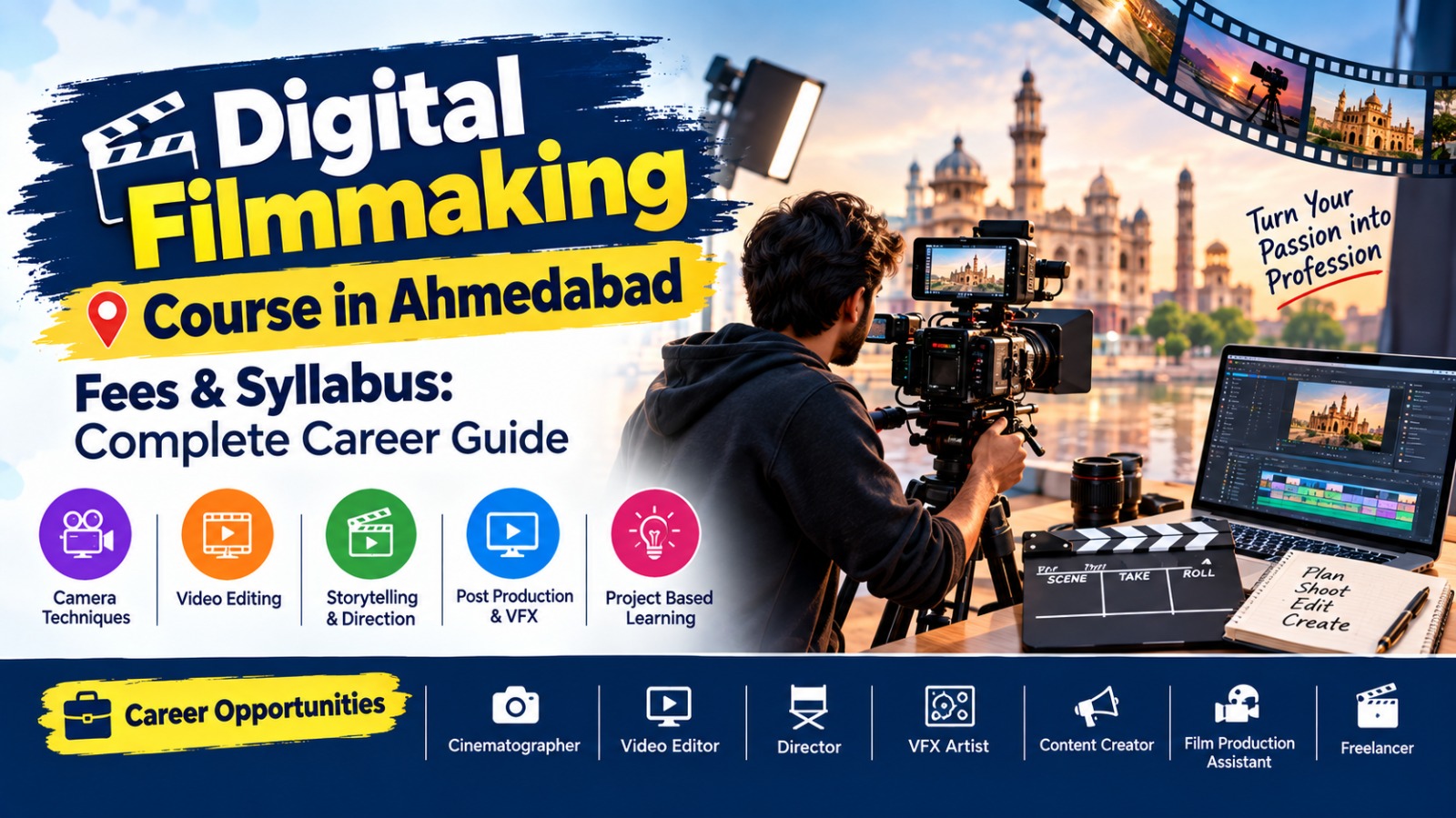
Digital video has become an important part of entertainment, advertising, education, social media, corporate communication and online content. From short-form videos and advertisements to documentaries, music videos and digital films, visual storytelling is used across many industries.
If you are interested in storytelling, cinematography, video production, editing and creative media, a Digital Filmmaking course can provide a structured way to develop these skills.
A Digital Filmmaking Course in Ahmedabad can introduce students to the complete production process, from developing an idea and writing a script to shooting, editing, sound design and final delivery.
This guide explains the fees, syllabus, duration, practical training, software, eligibility and career opportunities associated with Digital Filmmaking courses.
What Is a Digital Filmmaking Course?
A Digital Filmmaking course teaches the creative and technical processes involved in producing digital video content.
Depending on the course structure, students may learn:
- Storytelling
- Scriptwriting
- Screenwriting basics
- Storyboarding
- Cinematography
- Camera techniques
- Lighting
- Audio recording
- Video production
- Direction
- Video editing
- Colour correction
- Sound design
- Motion graphics
- Visual effects
- Post-production
The goal is to help learners understand how different production stages work together to create a finished video.
Why Learn Digital Filmmaking in Ahmedabad?
Ahmedabad has a growing digital ecosystem involving advertising agencies, businesses, educational organisations, digital marketing companies, content creators and media professionals.
Businesses increasingly use video for:
- Social media marketing
- Brand storytelling
- Product promotion
- Corporate communication
- Training
- Educational content
- Digital advertising
- YouTube content
- Short-form video
This creates a practical environment for learners who want to develop video production and digital content skills.
A good filmmaking course should combine classroom learning with hands-on production projects, allowing students to understand how ideas are converted into finished videos.
Digital Filmmaking Course Syllabus
The syllabus can vary depending on the institute, course level and duration. A comprehensive Digital Filmmaking course may include the following modules.
1. Introduction to Filmmaking
Students first understand the basic stages involved in filmmaking.
Topics may include:
- Pre-production
- Production
- Post-production
- Film language
- Visual storytelling
- Basic production planning
- Roles within a film production team
Understanding these stages helps students see how a film or video moves from concept to final output.
2. Storytelling and Idea Development
Storytelling is at the heart of filmmaking.
Students may learn:
- Idea generation
- Story structure
- Character development
- Narrative development
- Visual storytelling
- Scene development
- Story arcs
The objective is to communicate ideas effectively through visuals, dialogue, sound and editing.
3. Scriptwriting and Screenwriting
A script provides a structured plan for a production.
A filmmaking course may cover:
- Script formats
- Scene descriptions
- Dialogue
- Character introduction
- Scene transitions
- Story structure
- Short-video scripting
- Advertisement scripting
Students may practise writing scripts for short films, advertisements, social media videos and other digital formats.
4. Storyboarding
A storyboard visually represents the planned shots and scenes.
Students can learn how to plan:
- Camera angles
- Shot sizes
- Scene composition
- Character positions
- Movement
- Transitions
- Sequence of shots
Storyboarding can make production more organised and help communicate the director’s vision.
5. Cinematography
Cinematography is an important part of visual storytelling.
Students may learn about:
- Camera basics
- Camera movements
- Shot composition
- Framing
- Shot sizes
- Camera angles
- Depth of field
- Focus
- Exposure
- Visual continuity
Students can apply these concepts while shooting practical projects.
6. Camera Techniques
Digital filmmaking courses may introduce students to different camera techniques and equipment.
Topics can include:
- Camera setup
- Lens selection
- Manual controls
- Focus
- Exposure
- White balance
- Camera movement
- Tripod usage
- Handheld shooting
- Stabilisation
The exact equipment used depends on the institute and production setup.
7. Lighting for Filmmaking
Lighting influences the mood, visibility and visual quality of a scene.
Students may learn:
- Natural lighting
- Artificial lighting
- Key light
- Fill light
- Backlight
- Three-point lighting
- Light positioning
- Indoor lighting
- Outdoor lighting
- Creative lighting
Practical lighting exercises can help students understand how lighting changes a shot.
8. Audio and Sound Recording
Good visuals need good sound.
Students may learn:
- Microphone types
- Dialogue recording
- Ambient sound
- Sound levels
- Noise reduction
- Voice recording
- Sound effects
- Background music
- Audio mixing
Sound is particularly important in interviews, short films, documentaries and promotional videos.
9. Video Production
Production involves putting the planning into action.
Students may work on:
- Camera setup
- Lighting setup
- Shot planning
- Directing
- Working with actors or presenters
- Location planning
- Production coordination
- Continuity
- On-set workflow
Practical production assignments allow learners to experience the filmmaking process.
10. Video Editing
Editing brings individual shots together to create a complete story.
Students may learn:
- Importing footage
- Timeline editing
- Cutting and trimming
- Shot sequencing
- Transitions
- Audio synchronisation
- Text overlays
- Colour correction
- Export settings
Video editing is one of the most important post-production skills for digital filmmakers.
11. Colour Correction and Colour Grading
Colour can influence the mood and visual consistency of a video.
Students may learn the difference between:
Colour Correction:
Adjusting footage for exposure, white balance, contrast and consistency.
Colour Grading:
Creating a particular visual mood or style.
These skills can help transform raw footage into a more polished final production.
12. Motion Graphics and Visual Effects
Some Digital Filmmaking programs also introduce motion graphics and VFX.
Students may explore:
- Animated titles
- Lower thirds
- Logo animation
- Basic compositing
- Green-screen techniques
- Motion tracking
- Visual effects
- Animated graphics
These skills can be especially useful for advertisements, social media videos and digital campaigns.
13. Digital Content Creation
Modern filmmaking extends beyond traditional films.
Students may create:
- YouTube videos
- Instagram Reels
- Short-form videos
- Promotional videos
- Product videos
- Corporate videos
- Educational videos
- Interviews
- Documentaries
This allows learners to apply filmmaking principles to different digital platforms.
Digital Filmmaking Syllabus at a Glance
| Module | Key Learning Areas |
|---|---|
| Filmmaking Fundamentals | Production process and film language |
| Storytelling | Ideas, narrative and visual storytelling |
| Scriptwriting | Scripts, scenes and dialogue |
| Storyboarding | Shot planning and visualisation |
| Cinematography | Camera, composition and framing |
| Camera Techniques | Camera controls and movement |
| Lighting | Natural and artificial lighting |
| Sound | Recording, effects and audio |
| Production | Shooting and direction |
| Video Editing | Cutting, sequencing and transitions |
| Colour | Correction and grading |
| Motion Graphics | Titles and animated graphics |
| VFX | Compositing and visual effects |
| Portfolio | Films and practical projects |
The exact syllabus varies between institutes, so students should review the current course curriculum before admission.
Software Used in Digital Filmmaking
The software taught depends on the course and its specialisation.
Commonly used tools may include:
Adobe Premiere Pro
Used for professional video editing and post-production workflows.
Adobe After Effects
Used for motion graphics, compositing and visual effects.
Adobe Photoshop
Useful for creating graphics, thumbnails and supporting visual assets.
Adobe Audition
Can be used for audio editing and sound-related post-production.
DaVinci Resolve
Can support video editing, colour correction, colour grading and other post-production workflows.
The objective should not simply be to learn software menus. Students should understand how to use these tools to solve real production requirements.
Digital Filmmaking Course Fees in Ahmedabad
The Digital Filmmaking Course fees in Ahmedabad can vary depending on the institute and course structure.
Factors that can influence the fee include:
- Course duration
- Number of modules
- Practical production work
- Equipment access
- Editing software
- Cinematography training
- VFX and motion graphics modules
- Number of projects
- Certification
- Trainer experience
- Classroom or online learning
- Portfolio development
- Career assistance
Short-term filmmaking workshops may have a different fee structure from comprehensive professional courses.
Instead of comparing only the price, students should evaluate the syllabus, practical exposure, equipment, projects, portfolio development and overall learning support.
What Is the Duration of a Digital Filmmaking Course?
Course duration depends on the depth of the curriculum.
Short-Term Filmmaking Courses
These may focus on specific areas such as:
- Video editing
- Cinematography
- Camera operation
- Scriptwriting
- Short-film production
Comprehensive Digital Filmmaking Courses
Longer programs may combine:
- Storytelling
- Scriptwriting
- Cinematography
- Lighting
- Sound
- Direction
- Video editing
- Colour grading
- Motion graphics
- VFX
- Practical filmmaking
A longer program can provide more time for students to practise and create multiple projects.
Who Can Join a Digital Filmmaking Course?
Digital Filmmaking courses can be suitable for learners from different backgrounds.
Students After 12th
Students who have completed 12th can explore filmmaking, multimedia, animation and video-production courses, depending on the institute’s eligibility requirements.
College Students
College students can develop practical filmmaking and content-production skills alongside their academic education.
Graduates
Graduates from different fields can learn filmmaking as a specialised creative skill.
Working Professionals
Working professionals can use filmmaking skills for corporate communication, digital marketing, content creation and personal projects.
Content Creators
YouTubers, social media creators and aspiring filmmakers can develop stronger skills in scripting, shooting, editing and storytelling.
Practical Training in Digital Filmmaking
Filmmaking is a practical discipline, so hands-on experience is an important part of learning.
A practical course may include projects such as:
- Short film
- Documentary
- Product video
- Brand advertisement
- Interview video
- Music video
- Social media campaign
- Corporate video
- YouTube video
- Short-form vertical video
Students can experience different stages of production, including planning, shooting, editing and final delivery.
Portfolio Development for Filmmaking Students
A filmmaking portfolio can demonstrate practical skills more effectively than a certificate alone.
A portfolio may include:
- Short films
- Showreels
- Commercial videos
- Product videos
- Edited sequences
- Cinematography samples
- Motion graphics
- Documentary clips
- Social media videos
A showreel can be particularly useful because it presents selected work in a concise format.
Students should focus on showing their strongest work and clearly explaining their contribution to each project.
Career Opportunities After a Digital Filmmaking Course
After developing relevant skills and a portfolio, learners may explore different creative roles.
Possible career paths include:
- Filmmaker
- Assistant Director
- Video Editor
- Cinematographer
- Camera Operator
- Video Producer
- Content Creator
- Film Editor
- Motion Graphics Designer
- VFX Artist
- Production Assistant
- Scriptwriter
- Storyboard Artist
- Digital Content Producer
- Corporate Video Producer
Actual responsibilities and job titles vary depending on the organisation and level of experience.
Industries That Use Digital Filmmaking Skills
Digital filmmaking skills can be applied in several industries.
Advertising
Brands and agencies create video advertisements, promotional campaigns and product videos.
Digital Marketing
Businesses use video for social media, websites, campaigns and online advertising.
Entertainment
Film, television, OTT and digital entertainment projects require professionals across production and post-production.
Education
Educational organisations use videos, tutorials, explainers and digital learning content.
Corporate Sector
Companies create training videos, presentations, internal communication videos and promotional content.
Social Media
Short-form video has become an important content format across social platforms.
E-Learning
Online learning platforms use video to explain lessons and demonstrate concepts.
Freelancing After Digital Filmmaking Training
Digital filmmaking skills can also be used for freelance work.
Freelancers may provide services such as:
- Video editing
- Reels production
- Corporate videos
- Product videos
- Promotional videos
- YouTube editing
- Motion graphics
- Event videos
- Short-form advertisements
- Video post-production
Freelancing requires more than technical skills. Communication, client management, pricing, project planning and meeting deadlines are also important.
Digital Filmmaking and Social Media Content
The filmmaking industry is not limited to traditional films.
Businesses and creators increasingly produce:
- Instagram Reels
- YouTube Shorts
- Product videos
- Brand stories
- Tutorials
- Interviews
- Behind-the-scenes content
- Promotional campaigns
Learning cinematography, storytelling and editing can therefore be useful for both traditional and digital content production.
Role of AI in Modern Filmmaking
AI-assisted tools are increasingly being explored in creative workflows for tasks such as:
- Idea development
- Script brainstorming
- Production planning
- Concept exploration
- Editing assistance
- Transcription
- Content variations
However, filmmaking fundamentals remain important.
Skills such as storytelling, cinematography, directing, editing, sound and visual composition still require creative judgement.
Students should also understand copyright, licensing, consent and ethical considerations when using AI-assisted content in professional projects.
How to Choose a Digital Filmmaking Institute in Ahmedabad
Before enrolling in a Digital Filmmaking Institute in Ahmedabad, compare the following factors.
1. Syllabus
Check whether the curriculum covers the areas you want to learn.
2. Practical Projects
Ask how many filmmaking and video-production projects students complete.
3. Equipment
If cinematography is part of the course, understand what cameras, lights, microphones and other equipment are available for practice.
4. Editing Software
Check which editing, motion graphics and post-production tools are included.
5. Trainer Experience
Review the professional and teaching background of the trainers.
6. Portfolio Development
Ask whether students receive guidance to create films, showreels and other portfolio work.
7. Course Duration
Choose a program that provides enough time for practice and project completion.
8. Certification
Understand what certificate is provided and what it represents.
9. Career Support
If job assistance is offered, ask whether it includes resume preparation, interview support, portfolio guidance, internships or employer connections.
10. Learning Mode
Compare classroom, online and hybrid learning options based on your schedule and practical requirements.
Digital Filmmaking vs Video Editing
Digital Filmmaking and Video Editing are connected but not identical.
| Digital Filmmaking | Video Editing |
|---|---|
| Covers the complete production process | Focuses mainly on post-production |
| Includes storytelling | Focuses on assembling footage |
| Covers cinematography | Focuses on editing |
| May include directing | May include colour correction |
| Includes camera and lighting | Includes transitions and audio |
| Includes production planning | Includes final video preparation |
A filmmaking course generally provides broader exposure, while a video editing course may be more specialised.
Is Digital Filmmaking Suitable for Beginners?
Yes. Beginners can learn filmmaking through a structured progression.
A typical learning path can be:
Storytelling → Scriptwriting → Camera Basics → Cinematography → Lighting → Sound → Production → Editing → Colour → Portfolio
You do not need to know professional filmmaking before joining a beginner-level course.
Regular practice and project-based learning are important for developing confidence.
Skills to Develop Alongside Filmmaking
Technical knowledge is only one part of a filmmaking career.
Students should also develop:
- Storytelling
- Creativity
- Communication
- Visual observation
- Teamwork
- Problem-solving
- Time management
- Attention to detail
- Direction skills
- Project planning
- Presentation skills
These skills can help filmmakers work effectively with clients, actors, production teams and creative professionals.
Frequently Asked Questions
1. What is a Digital Filmmaking course?
A Digital Filmmaking course teaches the different stages of digital video production, including storytelling, scripting, cinematography, camera operation, lighting, sound, direction, editing, colour and post-production.
2. What are the fees for a Digital Filmmaking Course in Ahmedabad?
Fees vary according to the course duration, syllabus, equipment, practical projects, software, certification, trainer experience and learning mode. Students should check the current fee structure with the institute.
3. How long does a Digital Filmmaking course take?
Duration varies from short-term specialised programs to longer comprehensive courses. The exact duration depends on the curriculum and level of training.
4. Can I join a filmmaking course after 12th?
Yes. Students who have completed 12th can explore Digital Filmmaking and related creative-media courses, subject to the institute’s eligibility requirements.
5. Can beginners learn Digital Filmmaking?
Yes. Beginner courses generally introduce filmmaking fundamentals before progressing to advanced production and post-production techniques.
6. What software is used in Digital Filmmaking?
Depending on the course, students may learn software such as Adobe Premiere Pro, After Effects, Photoshop, Audition and DaVinci Resolve.
7. Is practical training important in filmmaking?
Yes. Practical shooting and production projects help students understand how storytelling, camera, lighting, sound and editing work together.
8. What career options are available after a Digital Filmmaking course?
Career options may include Video Editor, Cinematographer, Camera Operator, Filmmaker, Video Producer, Assistant Director, Content Creator, Motion Graphics Designer and Production Assistant.
9. Can I freelance after learning Digital Filmmaking?
Yes. Freelance opportunities can include video editing, social media videos, product videos, corporate videos, promotional content and post-production.
10. Is a filmmaking certificate enough to get a job?
A certificate alone does not guarantee employment. Practical experience, portfolio quality, technical skills, storytelling ability and professional communication are also important.
11. What should I check before joining a filmmaking course in Ahmedabad?
Compare the syllabus, practical projects, equipment, software, trainers, duration, fees, portfolio support, certification and career assistance.
Conclusion
A Digital Filmmaking Course in Ahmedabad can help aspiring filmmakers and content creators develop skills across the complete video-production process. From storytelling and scriptwriting to cinematography, lighting, sound, editing and post-production, students can learn how different creative disciplines work together.
The right course depends on your career interests. If you want to work across production and post-production, a comprehensive filmmaking program can provide broader exposure. If you are interested mainly in editing or cinematography, a specialised course may be more appropriate.
Before enrolling, compare the Digital Filmmaking course fees, syllabus, duration, practical training, equipment, software, portfolio projects and career support. Most importantly, choose a learning environment that gives you opportunities to practise, create real projects and develop a strong showreel or portfolio.
With consistent practice, creative thinking and technical skills, Digital Filmmaking can open pathways into advertising, digital marketing, entertainment, education, corporate communication, social media and independent content production.