Generative Artificial Intelligence has become an important part of modern digital workflows. Businesses, educators, marketers, designers, developers and content creators are using AI-powered systems to support tasks such as writing, research, brainstorming, image creation, coding, data analysis and productivity.
As these tools become more common, learning how to use them effectively is becoming a valuable digital skill.
If you are searching for a Generative AI Course in Ahmedabad, it is important to look beyond a list of AI tools. A useful course should explain the fundamentals of Generative AI, prompt design, responsible AI usage, practical workflows and real-world applications.
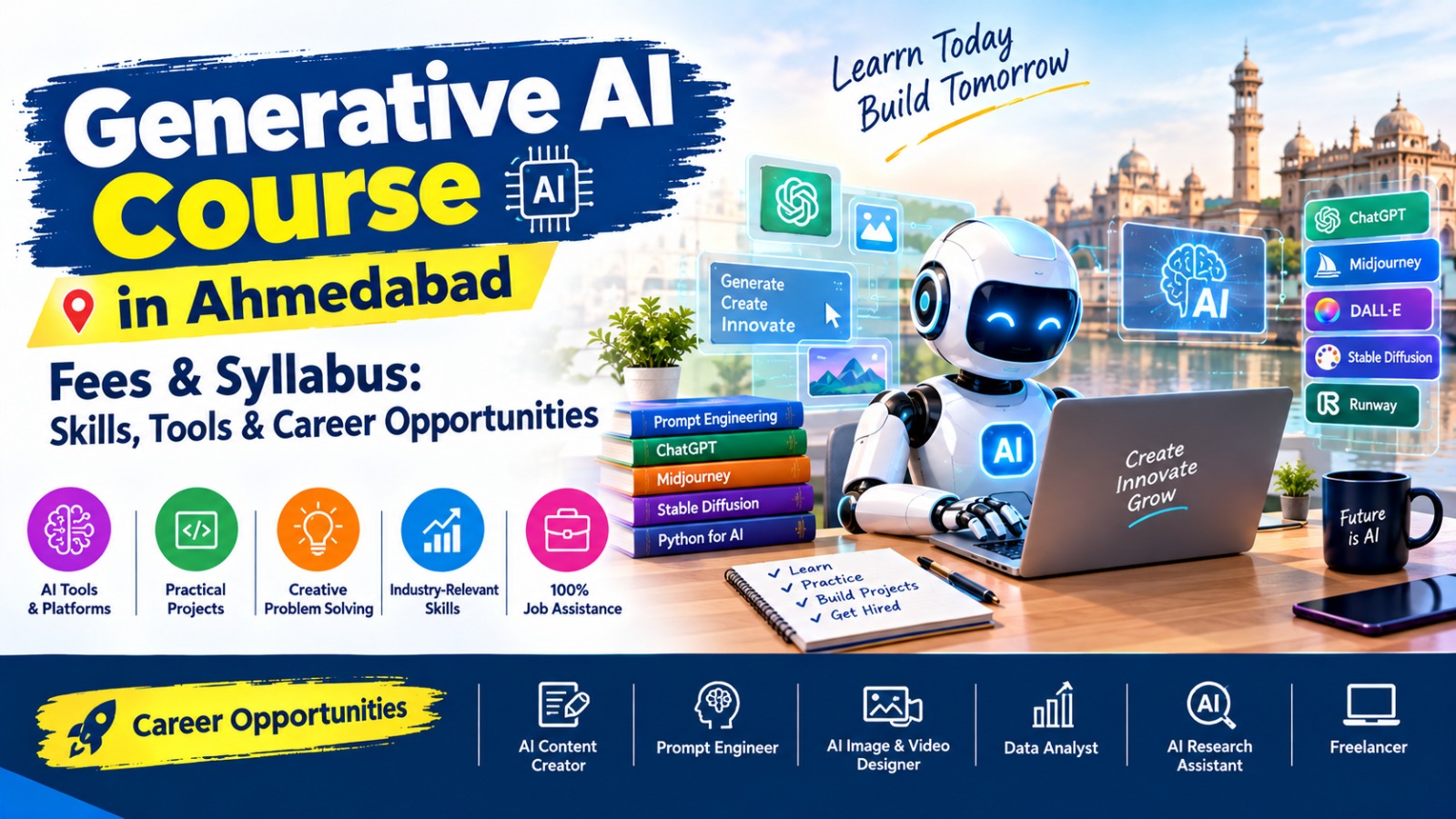
This guide covers Generative AI course fees, syllabus, duration, skills, tools, practical projects and career opportunities in Ahmedabad.
What Is Generative AI?
Generative AI refers to AI systems that can generate new content based on user instructions and learned patterns.
Depending on the system, Generative AI can help produce:
- Text
- Images
- Audio
- Video
- Code
- Summaries
- Ideas
- Presentations
- Structured information
For example, a user can provide a detailed instruction to an AI system and ask it to create a draft article, generate ideas, summarise information or assist with a coding task.
However, effective AI use requires more than simply entering a short question. Users need to understand how to provide context, define the desired output and review the result.
Why Learn Generative AI in Ahmedabad?
Ahmedabad has a growing ecosystem of businesses, startups, educational organisations, marketing agencies, IT companies and creative professionals.
Generative AI can support work across many of these areas.
Businesses may use AI-assisted workflows for:
- Content creation
- Marketing
- Customer communication
- Research
- Data analysis
- Presentations
- Design ideation
- Software development
- Administrative tasks
- Productivity
A Generative AI course can therefore be useful for students, professionals, business owners and creators who want to understand how AI can be incorporated into everyday workflows.
Generative AI Course Syllabus
The syllabus varies between institutes. A comprehensive Generative AI Course in Ahmedabad may include the following areas.
1. Introduction to Artificial Intelligence
Students begin with the basic concepts behind AI.
Topics may include:
- What is Artificial Intelligence?
- Machine Learning basics
- Deep Learning overview
- Generative AI
- AI models
- Training data
- AI applications
A strong foundation helps learners understand what Generative AI can and cannot do.
2. Understanding Generative AI
This module introduces the core concepts behind generative systems.
Students may learn about:
- Generative models
- Large Language Models
- Multimodal AI
- Text generation
- Image generation
- Code generation
- AI-assisted workflows
The depth of technical content depends on whether the course is designed for general users or technical learners.
3. Prompt Engineering
Prompting is an important practical skill when working with Generative AI.
Students may learn how to structure prompts using:
- Clear instructions
- Context
- Role definition
- Examples
- Constraints
- Desired output formats
- Step-by-step requirements
For example, instead of asking:
“Write a blog.”
a more structured prompt might specify:
“Write a 1,000-word beginner-friendly blog about digital marketing with headings, FAQs and a concise conclusion.”
The second prompt gives the AI clearer requirements and context.
4. Text Generation and Content Creation
Generative AI can assist with many text-based workflows.
Students may explore applications such as:
- Blog drafting
- Social media content
- Email writing
- Product descriptions
- Summaries
- Brainstorming
- Content outlines
- Research assistance
- Presentation content
The emphasis should be on reviewing and improving AI-generated output rather than publishing it without human checking.
5. AI for Research and Productivity
Generative AI can assist with everyday knowledge-work tasks.
Students may learn workflows for:
- Summarising information
- Creating notes
- Organising ideas
- Brainstorming
- Creating checklists
- Drafting documents
- Analysing provided information
- Preparing presentations
Users should learn to verify important information because AI-generated responses can contain errors or unsupported claims.
6. Generative AI for Images
Image-generation systems can support creative ideation and visual content workflows.
Students may explore:
- Text-to-image concepts
- Prompt-based image creation
- Creative direction
- Image variations
- Visual references
- Composition instructions
- Editing workflows
AI-generated visuals should be reviewed for quality, suitability and appropriate usage rights before being used commercially.
7. AI for Video and Creative Content
Some Generative AI programs also introduce AI-assisted video workflows.
Applications may include:
- Video concepts
- Script development
- Storyboards
- Visual ideation
- Captions
- Content variations
- Editing assistance
The exact tools covered depend on the institute and the course syllabus.
8. AI for Presentations
Generative AI can help users develop presentation ideas and content structures.
Students may learn to use AI for:
- Presentation outlines
- Slide content
- Speaker notes
- Visual ideas
- Summaries
- Content restructuring
Human review remains important to ensure accuracy and appropriate communication.
9. Generative AI for Coding
Some courses introduce AI-assisted programming workflows.
Depending on the program, students may learn how AI can help with:
- Code generation
- Code explanation
- Debugging assistance
- Documentation
- Code refactoring
- Learning programming concepts
Technical learners may benefit from a more advanced module covering AI-assisted development workflows.
10. AI for Digital Marketing
Generative AI has applications across digital marketing.
Students may explore AI-assisted workflows for:
- Content ideas
- SEO content planning
- Social media posts
- Ad copy
- Email campaigns
- Customer personas
- Content calendars
- Keyword research support
- Marketing brainstorming
AI-generated marketing content should still be reviewed for brand consistency, factual accuracy and originality.
11. AI for Graphic Design and Creative Workflows
Creative professionals can use Generative AI as an assistance tool for ideation and workflow development.
Possible applications include:
- Creative concepts
- Moodboards
- Design references
- Content variations
- Visual brainstorming
- Copywriting support
- Image editing assistance
However, fundamental design skills such as typography, composition, colour, layout and visual hierarchy remain important.
12. Responsible and Ethical AI
A useful Generative AI course should also discuss responsible usage.
Topics may include:
- AI-generated errors
- Hallucinations
- Privacy
- Copyright
- Licensing
- Bias
- Misinformation
- Data security
- Human review
- Responsible prompting
Understanding limitations is as important as learning the tools themselves.
Generative AI Syllabus at a Glance
| Module | Key Learning Areas |
|---|---|
| AI Fundamentals | AI, ML, Deep Learning basics |
| Generative AI | Models, LLMs and applications |
| Prompt Engineering | Instructions, context and output control |
| Text Generation | Writing, summaries and ideation |
| Productivity | Research and workflow assistance |
| Image Generation | Prompts and visual ideation |
| Video Applications | Scripts, concepts and content |
| Presentations | Slides, outlines and summaries |
| AI for Coding | Code generation and assistance |
| AI for Marketing | Content and campaign workflows |
| AI for Design | Creative ideation and visual workflows |
| Responsible AI | Privacy, copyright and limitations |
| Practical Projects | Real-world AI workflows |
The exact modules and depth can differ significantly between beginner, professional and technical courses.
Generative AI Tools Covered in Courses
The tools covered depend on the training provider and the current course curriculum.
A course may introduce categories such as:
AI Chat and Text Tools
Used for:
- Writing
- Brainstorming
- Summarisation
- Research assistance
- Content planning
Image Generation Tools
Used for:
- Concept development
- Visual references
- Creative experimentation
- Image generation
AI Video Tools
Used for:
- Video concepts
- Content creation
- Storyboarding
- Video assistance
AI Coding Tools
Used for:
- Code generation
- Debugging assistance
- Code explanation
- Documentation
Because AI tools change rapidly, students should focus on transferable skills such as prompting, evaluation, workflow design and responsible AI use, rather than learning only one specific tool.
Skills You Can Develop Through a Generative AI Course
A structured course can help learners develop several practical skills.
1. Prompt Writing
Learn how to communicate requirements clearly to AI systems.
2. AI-Assisted Content Creation
Use AI to support writing, brainstorming and content planning.
3. AI Workflow Design
Understand how AI can fit into existing professional processes.
4. Critical Evaluation
Learn to review AI-generated content for accuracy and relevance.
5. Creative Ideation
Use AI to explore concepts and possible directions.
6. Productivity
Use AI to support repetitive and time-consuming knowledge-work tasks.
7. Research Support
Use AI to organise and summarise information while verifying important facts.
8. Responsible AI Usage
Understand privacy, copyright, bias and limitations.
Generative AI Course Fees in Ahmedabad
The Generative AI Course fees in Ahmedabad can vary depending on several factors.
These may include:
- Course duration
- Beginner or advanced level
- Number of AI tools covered
- Practical projects
- Trainer experience
- Technical depth
- Certification
- Classroom or online training
- Industry-focused modules
- Career support
Short-term introductory courses may have a different fee structure from comprehensive professional programs.
When comparing fees, students should consider the quality of practical training, syllabus, projects and learning support, rather than looking only at the lowest price.
What Is the Duration of a Generative AI Course?
Course duration depends on the learning objectives.
Short-Term Courses
Short programs may focus on:
- AI fundamentals
- Prompt engineering
- AI productivity
- Basic content creation
Comprehensive Courses
Longer programs may cover:
- AI fundamentals
- Prompt engineering
- Text generation
- Image generation
- Video workflows
- Marketing
- Design
- Coding assistance
- Automation
- Practical projects
The right duration depends on whether you want basic awareness, professional workflow skills or deeper technical knowledge.
Who Can Join a Generative AI Course?
Generative AI is relevant to learners from different backgrounds.
Students
Students can learn AI-assisted productivity, research and creative workflows.
Working Professionals
Professionals can explore ways to integrate AI into everyday tasks.
Digital Marketers
Digital marketers can use AI for content planning, campaign ideation and communication.
Graphic Designers
Designers can explore AI-assisted ideation and creative workflows.
Content Creators
Creators can use AI for brainstorming, scripts, captions and content development.
Business Owners
Entrepreneurs can learn how AI can support productivity, marketing and business workflows.
Beginners
Many beginner-level courses do not require advanced programming knowledge.
Practical Projects in a Generative AI Course
Practical assignments can help learners move from theory to application.
Projects may include:
- AI-assisted blog creation
- Social media content plan
- Marketing campaign concept
- AI-generated visual concept
- Presentation creation
- Customer communication workflow
- AI-assisted research project
- Product description workflow
- AI-assisted coding project
- Business productivity workflow
The best projects should demonstrate not only the use of AI tools but also the learner’s ability to evaluate and improve the output.
Generative AI for Digital Marketing
Generative AI can support many digital marketing activities.
For example, marketers can use AI-assisted workflows for:
- Content calendars
- Blog outlines
- Social media ideas
- Ad-copy drafts
- Email drafts
- Customer personas
- Campaign brainstorming
- Video scripts
- Content repurposing
However, AI-generated content should be checked for factual accuracy, originality, brand tone and search quality before publication.
Generative AI for Graphic Design
Graphic designers can use Generative AI as part of an ideation process.
It can support:
- Concept exploration
- Moodboard development
- Creative references
- Image variations
- Visual brainstorming
- Content creation assistance
However, designers still need strong fundamentals in:
- Typography
- Colour
- Composition
- Layout
- Branding
- Visual hierarchy
Generative AI works best as part of a broader creative workflow rather than as a replacement for design knowledge.
Generative AI and Automation
Some advanced courses may introduce AI-assisted automation.
Automation can help connect AI with repetitive workflows such as:
- Content processing
- Information organisation
- Document workflows
- Customer communication
- Data processing
- Task management
The depth of automation training depends on the course and whether it is designed for general users or technical professionals.
Generative AI Course After 12th
Students after 12th can consider a beginner-friendly Generative AI course to build modern digital skills.
A beginner pathway can include:
AI Fundamentals → Generative AI → Prompt Engineering → AI Tools → Practical Projects → Portfolio
Students can combine AI learning with fields such as:
- Digital Marketing
- Graphic Design
- UI/UX
- Animation
- Web Development
- Business
- Content Creation
AI skills can complement an existing professional or academic area.
Generative AI for Working Professionals
Working professionals may benefit from courses that focus on practical workplace applications rather than highly technical theory.
Possible applications include:
- Writing assistance
- Research
- Presentations
- Data organisation
- Communication
- Marketing
- Documentation
- Productivity
- Brainstorming
Flexible online or classroom programs may be considered based on work schedules.
Career Opportunities After a Generative AI Course
Generative AI is a skill that can be applied across existing roles rather than representing only one specific job title.
Depending on a learner’s background, AI skills can complement roles such as:
- Digital Marketing Executive
- Content Creator
- Content Strategist
- Social Media Executive
- Graphic Designer
- UI/UX Designer
- Business Analyst
- Research Assistant
- AI Content Specialist
- Marketing Executive
- Automation Specialist
- AI-Assisted Developer
Career opportunities depend on the learner’s core skills, practical experience, portfolio and ability to apply AI effectively.
Is a Generative AI Certificate Enough for a Job?
A certificate alone does not guarantee employment.
Employers may also look at:
- Practical skills
- Existing professional knowledge
- AI workflow experience
- Problem-solving ability
- Portfolio projects
- Communication skills
- Ability to verify AI output
For example, a digital marketer who understands both marketing fundamentals and AI-assisted workflows may be able to demonstrate AI as part of a broader professional skill set.
How to Choose a Generative AI Institute in Ahmedabad
Before enrolling in a Generative AI Institute in Ahmedabad, compare the following factors.
1. Syllabus
Check whether the course covers fundamentals, prompting, practical applications and responsible AI.
2. Tool Coverage
Find out which tools are included and whether the course focuses on transferable concepts.
3. Practical Training
Ask whether students complete real-world assignments.
4. Trainer Experience
Consider the trainer’s experience with AI tools and practical workflows.
5. Project-Based Learning
Check whether the course includes portfolio-worthy projects.
6. Course Duration
Choose a duration that gives enough time for practice.
7. Certification
Understand what the certificate represents.
8. Learning Mode
Compare classroom, online and hybrid options.
9. Career Support
If career assistance is offered, understand whether it includes resume guidance, interview preparation, portfolio development or employer connections.
Generative AI vs Traditional AI Courses
Generative AI and traditional AI courses can have different learning objectives.
| Generative AI Course | Traditional/Technical AI Course |
|---|---|
| Focuses on generative systems and applications | Often focuses on broader AI/ML concepts |
| Prompt engineering may be included | Programming and mathematics may be more prominent |
| Content generation workflows | Machine learning model development |
| AI productivity | Data and model training |
| Creative applications | Technical implementation |
| Suitable for many non-technical users | Often requires stronger technical foundations |
The appropriate choice depends on whether your goal is using AI tools effectively or learning the technical foundations of AI and machine learning.
Benefits of Learning Generative AI
A well-structured course can help learners:
- Understand modern AI concepts
- Improve digital productivity
- Develop prompt-writing skills
- Explore AI-assisted creativity
- Support content creation
- Experiment with AI workflows
- Understand AI limitations
- Build practical projects
- Add AI skills to an existing career
The value of the course depends heavily on how effectively learners apply these skills to real tasks.
Frequently Asked Questions
1. What is a Generative AI course?
A Generative AI course teaches learners how generative AI systems work at a practical level and how to use them for tasks such as writing, research, image creation, productivity, marketing, coding and creative workflows.
2. What are the fees for a Generative AI Course in Ahmedabad?
Fees vary according to course duration, syllabus, tools, practical projects, trainer experience, certification and learning mode. Students should check the current fee structure with the institute.
3. What is included in a Generative AI syllabus?
A syllabus may include AI fundamentals, Generative AI concepts, prompt engineering, text generation, image generation, productivity, marketing, coding assistance, responsible AI and practical projects.
4. Is Generative AI suitable for beginners?
Yes. Beginner-level courses can introduce Generative AI without requiring advanced programming knowledge, depending on the course structure.
5. Can I learn Generative AI after 12th?
Yes. Students after 12th can learn Generative AI as a digital skill and combine it with areas such as digital marketing, design, business, content creation or technology.
6. Which Generative AI tools are taught?
The tools vary by institute and may change over time. Courses can cover AI chat tools, image-generation tools, video tools, coding assistants and productivity platforms.
7. Do I need programming knowledge to learn Generative AI?
Not necessarily. Many beginner and professional-user courses focus on prompting and practical applications rather than programming. Technical Generative AI courses may require programming knowledge.
8. What skills can I develop through a Generative AI course?
You can develop skills in prompt engineering, AI-assisted content creation, workflow design, productivity, creative ideation, AI evaluation and responsible AI usage.
9. What career opportunities are available after a Generative AI course?
Generative AI can complement careers in digital marketing, content creation, design, business analysis, development, research and other digital professions. The specific opportunity depends on your broader skill set.
10. Is a Generative AI certificate enough for a job?
No certificate can guarantee employment. Practical skills, projects, professional knowledge, portfolio quality and the ability to apply AI responsibly are also important.
11. How long does a Generative AI course take?
Duration varies from short-term introductory programs to comprehensive professional courses. The appropriate duration depends on the depth of skills and applications you want to learn.
12. How should I choose a Generative AI course in Ahmedabad?
Compare the syllabus, practical projects, tools, trainer experience, duration, fees, certification, learning mode and career support before enrolling.
Conclusion
A Generative AI Course in Ahmedabad can help students and professionals understand how modern AI systems can support content creation, research, productivity, marketing, design, coding and other digital workflows.
The most useful learning approach goes beyond simply collecting knowledge of different AI tools. Learners should develop prompt engineering, critical evaluation, workflow design, creative thinking and responsible AI skills.
Before selecting a course, compare the fees, syllabus, duration, practical training, tools, projects, certification and career support. Since AI tools continue to evolve, prioritising transferable skills can help learners adapt as new technologies and workflows emerge.
For students, working professionals and digital creators in Ahmedabad, Generative AI can be a valuable complementary skill when combined with a strong foundation in their chosen field.