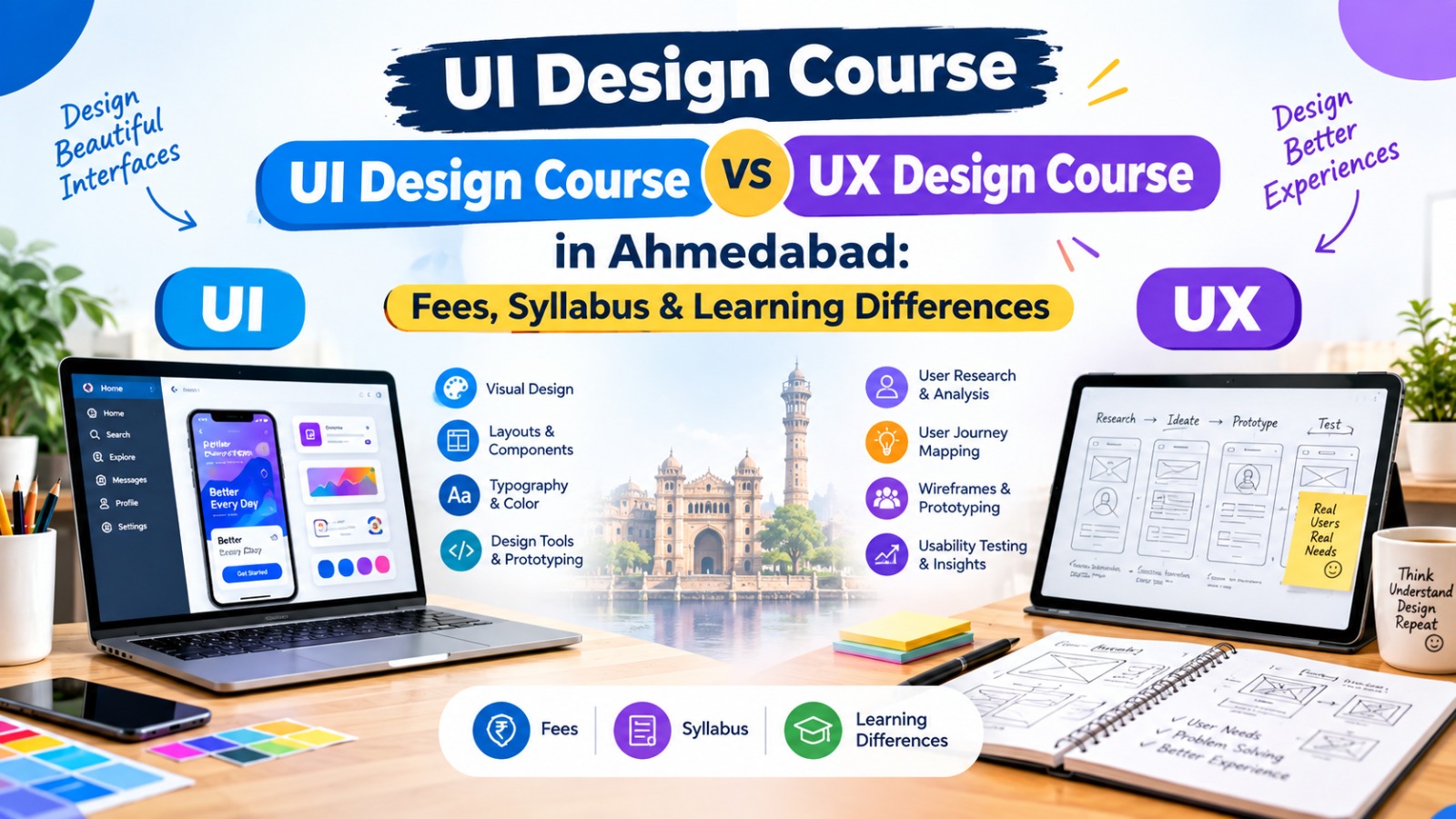
UI and UX design are two closely connected areas of digital product design, but they focus on different parts of the user experience.
If you are searching for a UI Design Course in Ahmedabad or a UX Design Course in Ahmedabad, understanding the difference between the two can help you select a course that matches your interests, learning style and career goals.
UI Design primarily focuses on how a digital product looks and communicates visually. UX Design focuses on how the product works, how users interact with it and whether the overall experience is convenient and effective.
Although UI and UX can be learned separately, many modern training programs combine them into a UI/UX Design Course because both skill sets are useful when designing websites, mobile applications and digital products.
What Is UI Design?
UI stands for User Interface.
UI design is concerned with the visual and interactive elements that users see and interact with when using a website, mobile application or digital product.
A UI designer may work on:
- Colours
- Typography
- Buttons
- Icons
- Navigation elements
- Layouts
- Spacing
- Cards
- Forms
- Images
- Design systems
- Responsive screens
- Visual hierarchy
- Interactive states
The goal is to create interfaces that are visually clear, consistent and easy to understand.
For example, when designing a mobile banking application, a UI designer may determine how the login screen, buttons, account dashboard, transaction cards and navigation menu should look.
What Is UX Design?
UX stands for User Experience.
UX design focuses on the overall experience a person has while using a product or service.
Instead of concentrating mainly on appearance, UX designers investigate questions such as:
- Who are the users?
- What are they trying to accomplish?
- What problems do they face?
- How should information be organised?
- What steps should users follow?
- Where might users become confused?
- How can the product become easier to use?
UX designers may work with:
- User research
- User personas
- Customer journeys
- User journeys
- Information architecture
- User flows
- Wireframes
- Prototypes
- Usability testing
- Interaction design
- Problem-solving
For example, for the same banking application, a UX designer may plan how users transfer money, locate transaction history and complete a payment with as few unnecessary steps as possible.
UI Design vs UX Design: Key Differences
| Factor | UI Design | UX Design |
|---|---|---|
| Full Form | User Interface | User Experience |
| Main Focus | Visual interface | Overall user experience |
| Main Question | How should it look and feel? | How should it work? |
| Major Skills | Visual design, typography, colour, layout | Research, problem-solving, user flows |
| Typical Work | Screens and visual components | User journeys and product experiences |
| Common Deliverables | UI screens, design systems, visual assets | Personas, journeys, wireframes, prototypes |
| Important Tools | Figma, Photoshop, Illustrator | Figma, FigJam and research/prototyping tools |
| Creativity | Strong visual creativity | Strong analytical and problem-solving skills |
| Testing | Visual and interaction consistency | Usability and user experience |
| Career Direction | UI Designer, Visual Designer | UX Designer, UX Researcher |
Both fields overlap, and many designers develop skills in both.
UI Design Course in Ahmedabad: What Will You Learn?
A UI Design course generally concentrates on visual communication and digital interface design.
A typical UI Design syllabus may include:
1. Design Fundamentals
Students learn fundamental principles such as:
- Balance
- Contrast
- Alignment
- Proportion
- Hierarchy
- Repetition
- Consistency
- Visual rhythm
These principles form the foundation of professional interface design.
2. Colour Theory
Colour plays an important role in communicating information and creating visual hierarchy.
Topics may include:
- Colour combinations
- Contrast
- Colour psychology
- Accessibility considerations
- Brand colours
- Background and foreground relationships
3. Typography
Typography involves selecting and arranging fonts so that content remains readable and visually consistent.
Students may learn:
- Font selection
- Font pairing
- Font hierarchy
- Line spacing
- Letter spacing
- Text alignment
- Responsive typography
4. Layout and Composition
Students learn how to organise elements on a screen.
Topics can include:
- Grids
- Spacing
- Alignment
- Visual hierarchy
- Responsive layouts
- Component placement
5. UI Components
A UI course may cover common interface elements such as:
- Buttons
- Forms
- Navigation bars
- Cards
- Dropdowns
- Tabs
- Modals
- Input fields
- Notifications
6. Design Systems
Students can learn how reusable components and design rules help maintain consistency across digital products.
UX Design Course in Ahmedabad: What Will You Learn?
A UX Design Course in Ahmedabad generally focuses on understanding users and designing practical digital experiences.
A typical UX syllabus may include:
1. Introduction to UX Design
Students understand:
- UX principles
- User-centred design
- Design thinking
- Product design processes
- UX terminology
2. User Research
Research helps designers understand users before designing a solution.
Topics can include:
- User interviews
- Surveys
- Competitor research
- User observations
- Research documentation
- Identifying user problems
3. User Personas
A persona represents a target user and helps designers understand their goals, needs and challenges.
4. User Journey Mapping
Students learn to visualise the different stages a user may experience while interacting with a product or service.
5. Information Architecture
Information architecture focuses on organising content and features logically.
For example, an e-commerce website needs a clear structure for:
- Categories
- Products
- Filters
- Search
- Product details
- Cart
- Checkout
6. User Flows
User flows show the steps a user takes to complete a particular task.
7. Wireframing
Wireframes provide a basic structure for screens before detailed visual design is added.
8. Prototyping
Students learn how to connect screens and create interactive prototypes that simulate product behaviour.
9. Usability Testing
Testing helps identify problems users may experience while interacting with a design.
UI Design Course vs UX Design Course: Syllabus Comparison
| Syllabus Area | UI Design | UX Design |
|---|---|---|
| Design Fundamentals | ✓ | ✓ |
| Colour Theory | ✓ | Basic |
| Typography | ✓ | Basic |
| Visual Design | ✓ | Limited |
| Layout | ✓ | ✓ |
| User Research | Basic | ✓ |
| Personas | Basic | ✓ |
| User Journey | Basic | ✓ |
| Information Architecture | Basic | ✓ |
| User Flows | ✓ | ✓ |
| Wireframing | ✓ | ✓ |
| Prototyping | ✓ | ✓ |
| Design Systems | ✓ | ✓ |
| Usability Testing | Basic | ✓ |
| Visual Components | ✓ | Basic |
| Interaction Design | ✓ | ✓ |
The exact syllabus can vary between institutes and course levels, so students should review the module list before enrolling.
UI Design Course Fees in Ahmedabad
The UI Design Course fees in Ahmedabad can vary depending on several factors.
These may include:
- Course duration
- Beginner or advanced level
- Classroom or online training
- Number of practical projects
- Software and tools covered
- Portfolio development
- Certification
- Trainer experience
- Placement or career support
- Individual or group training
Short-term introductory courses may have a different fee structure from comprehensive professional programs.
Instead of choosing a course based only on price, compare the syllabus, practical training, projects, portfolio support and learning outcomes.
UX Design Course Fees in Ahmedabad
The UX Design Course fees in Ahmedabad also vary depending on the structure and depth of training.
A comprehensive course may include:
- UX fundamentals
- Research
- Personas
- User journeys
- Information architecture
- Wireframing
- Prototyping
- Usability testing
- Real-world projects
- Portfolio development
Before enrolling, ask the institute for the current fee, course duration, syllabus and what is included in the program.
UI vs UX: Which Course Is Easier for Beginners?
There is no universal answer because difficulty depends on an individual’s interests and existing skills.
Students who enjoy:
- Visual creativity
- Colours
- Typography
- Layout
- Branding
- Digital graphics
may find UI design more naturally aligned with their interests.
Students who enjoy:
- Research
- Problem-solving
- Understanding users
- Logical thinking
- Product improvement
- Planning user journeys
may find UX design more aligned with their interests.
However, beginners do not necessarily need to choose only one.
A combined UI/UX Design Course can provide an introduction to both disciplines.
Can You Learn UI and UX Together?
Yes.
UI and UX are different disciplines, but they are closely connected.
A typical product design process may involve:
Research → User Problems → User Journey → Information Architecture → Wireframe → UI Design → Prototype → Testing → Improvements
This is why many students choose a combined UI/UX program.
Learning both can help students understand the relationship between:
User needs + functionality + usability + visual design
Tools Used in UI and UX Design Courses
The tools taught depend on the institute and course level.
Common tools include:
Figma
Figma is widely used for interface design, wireframing, prototyping and collaborative design workflows.
FigJam
FigJam can be used for brainstorming, workshops, user journeys and collaborative planning.
Adobe Photoshop
Photoshop can support image editing and visual design tasks.
Adobe Illustrator
Illustrator is useful for vector graphics, icons, illustrations and branding-related work.
The most important factor is not simply learning software. Students should understand why and how each tool is used to solve a design problem.
Practical Training: What Should a Good Course Include?
Whether you choose UI, UX or UI/UX training, practical work is important.
A course can include projects such as:
- Mobile application interface
- Website redesign
- E-commerce website
- Food delivery application
- Travel application
- Banking application
- Education platform
- Healthcare website
- Portfolio website
For UX projects, students can work through research, user flows, wireframes and testing.
For UI projects, they can develop high-fidelity screens, visual systems and responsive interfaces.
Portfolio Development in UI/UX Courses
A portfolio is an important part of demonstrating design skills.
Instead of showing only the final design, a strong portfolio can explain the design process.
A UX case study may include:
- Problem statement
- Research
- User persona
- User journey
- Information architecture
- User flow
- Wireframes
- Prototype
- Testing
- Final solution
A UI case study may focus more on:
- Design objective
- Visual direction
- Colour palette
- Typography
- Layout
- Components
- High-fidelity screens
- Responsive designs
- Final interface
This allows potential employers or clients to understand how the designer approaches a project.
Career Opportunities After UI Design Training
After developing UI design skills and a portfolio, learners may explore roles such as:
- UI Designer
- Visual Designer
- Interface Designer
- Digital Designer
- Creative Designer
- Product Designer
- Junior UI Designer
- Visual Communication Designer
The actual role depends on the organisation, experience and skill set.
Career Opportunities After UX Design Training
UX-focused learners may explore roles such as:
- UX Designer
- UX Researcher
- Product Designer
- Interaction Designer
- User Experience Designer
- Information Architect
- Junior UX Designer
Some roles combine UI and UX responsibilities, particularly in smaller teams.
Who Should Choose a UI Design Course?
A UI Design course may be suitable for learners who enjoy:
- Visual creativity
- Digital design
- Colours and typography
- Layout and composition
- Branding
- Website interfaces
- Mobile app screens
- Visual communication
It can also be useful for students from graphic design or visual communication backgrounds who want to move into digital product interfaces.
Who Should Choose a UX Design Course?
A UX Design course may be suitable for learners interested in:
- User behaviour
- Research
- Problem-solving
- Product improvement
- User journeys
- Information organisation
- Usability
- Digital products
It can be a useful direction for people who enjoy analysing problems and developing structured solutions.
Who Should Choose a UI/UX Design Course?
A combined UI/UX course can be considered if you want to understand the complete design process.
It can be particularly useful for:
- Students after 10th or 12th
- College students
- Graduates
- Graphic designers
- Digital marketing professionals
- Website professionals
- Freelancers
- Career changers
- Working professionals
The ideal course depends on your existing skills, available learning time and career objectives.
UI Design vs UX Design: Learning Time
Course duration varies by institute and course depth.
A short-term program may focus on fundamentals and selected tools, while a comprehensive program may provide more time for:
- Research
- Design principles
- Wireframing
- Prototyping
- UI design
- Practical projects
- Portfolio development
- Testing
When comparing courses in Ahmedabad, look beyond the number of classroom hours and check how much practical work is included.
How to Choose a UI/UX Design Institute in Ahmedabad
Before enrolling in a UI UX Design Institute in Ahmedabad, consider the following factors:
1. Course Syllabus
Check whether the syllabus covers the skills you want to learn.
2. Practical Projects
Ask whether students create real-world or project-based assignments.
3. Portfolio Support
Find out whether the course helps you develop case studies and portfolio projects.
4. Software Training
Check which design tools are included.
5. Trainer Experience
Understand the trainer’s design and teaching background.
6. Learning Mode
Compare classroom, online and hybrid options based on your schedule.
7. Certification
Check what type of certificate is provided and what it represents.
8. Career Support
If job assistance is offered, understand what it includes, such as resume guidance, interview preparation, portfolio review or employer connections.
9. Course Duration
Choose a duration that allows enough time for practice rather than selecting a program only because it is short.
UI Design vs UX Design: Which One Should You Learn?
The answer depends on what you want to focus on.
If you are mainly interested in visual interface design, a UI Design course may be a suitable starting point.
If you are more interested in user research, usability and problem-solving, a UX Design course may be more relevant.
If you want to understand both visual design and user experience, a UI/UX Design Course in Ahmedabad can provide broader exposure.
The most useful approach is to compare the syllabus, practical projects, portfolio development, tools, course duration and overall learning structure before making a decision.
Frequently Asked Questions
1. What is the difference between UI and UX Design?
UI Design focuses primarily on the visual interface and interactive elements of a product, while UX Design focuses on the overall user experience, usability and problem-solving process.
2. Which is better, UI Design or UX Design?
Neither is universally better. UI and UX solve different parts of the product design process. The right choice depends on your interests, strengths and career goals.
3. What are the fees for UI Design courses in Ahmedabad?
UI Design course fees vary based on course duration, syllabus, practical projects, tools, certification, learning mode and other features. Students should check the current fee structure directly with the institute.
4. What are the fees for UX Design courses in Ahmedabad?
UX course fees vary according to the depth of the curriculum, duration, practical training, projects, portfolio support and other course features.
5. Can beginners learn UI Design?
Yes. Beginners can start with design fundamentals, colour theory, typography, layout, interface design and commonly used design tools.
6. Can beginners learn UX Design?
Yes. A beginner-friendly UX course can introduce students to research, personas, user journeys, information architecture, wireframing, prototyping and usability testing.
7. Can I learn UI and UX together?
Yes. A combined UI/UX course can help learners understand both the visual and experience sides of digital product design.
8. Which tools are used in UI/UX design?
Common tools include Figma, FigJam, Photoshop and Illustrator. The exact tools covered depend on the course and institute.
9. Is a certificate enough to get a UI/UX job?
A certificate alone does not guarantee employment. Practical skills, portfolio quality, problem-solving ability and the ability to explain design decisions are also important.
10. Is UI/UX design suitable for working professionals?
Yes. Working professionals can choose classroom, online or flexible programs depending on their schedule and learning requirements.
11. What should I check before joining a UI/UX course in Ahmedabad?
Compare the syllabus, practical projects, tools, trainers, portfolio development, course duration, fees, certification and career support before enrolling.
Conclusion
UI Design and UX Design are closely related but focus on different aspects of digital product development.
UI Design focuses more on the visual appearance, interface components and interactive presentation of a digital product. UX Design focuses more on users, research, usability, information structure and the overall experience.
For learners in Ahmedabad, the choice between a UI Design Course and a UX Design Course should be based on personal interests and career objectives. Those interested in visual creativity may prefer UI, while learners who enjoy research and problem-solving may prefer UX.
For broader digital product design knowledge, a UI/UX Design Course in Ahmedabad can combine both areas through practical projects, wireframes, prototypes, interface design and portfolio development.
Before enrolling, compare the syllabus, practical training, tools, duration, fees, portfolio support and career assistance to find a learning program that fits your goals.