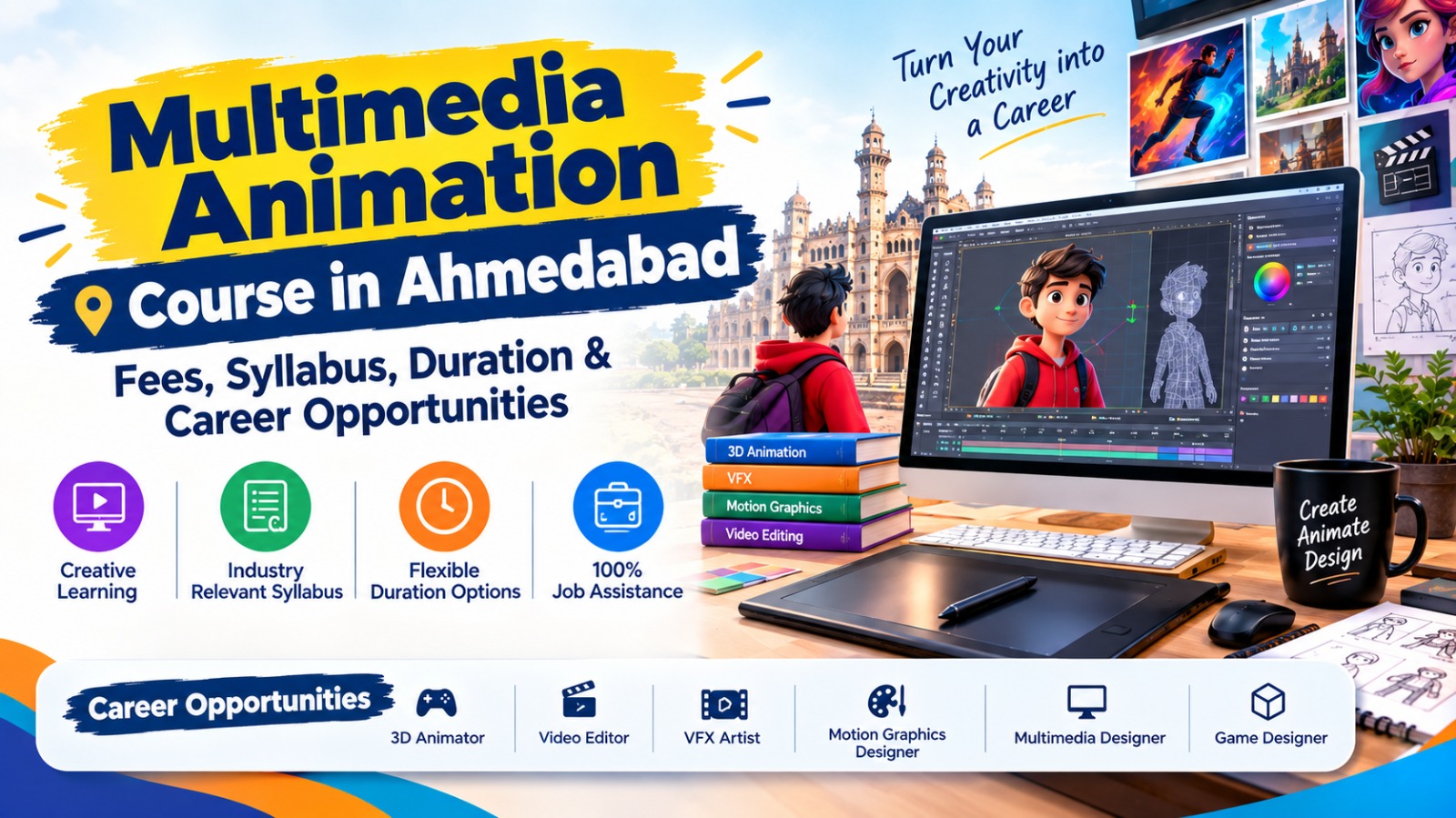
The demand for engaging visual content has expanded across advertising, entertainment, education, digital media, gaming, social media and corporate communication. This has created opportunities for people with skills in animation, visual storytelling, motion graphics, video editing and multimedia production.
If you are searching for a Multimedia Animation Course in Ahmedabad, you may come across programs with different names, durations and specialisations. Some focus on 2D animation, while others combine 3D animation, VFX, motion graphics, video editing and digital filmmaking.
Understanding the fees, syllabus, course duration, software, practical training and career opportunities can help you select a course that matches your interests.
What Is a Multimedia Animation Course?
A Multimedia Animation course teaches students how to create and communicate ideas through visual, animated and digital media.
Depending on the course structure, students may learn:
- Design fundamentals
- Drawing and visualisation
- 2D animation
- 3D animation
- Motion graphics
- Video editing
- Visual effects
- Storyboarding
- Character design
- Digital compositing
- Digital filmmaking
- Audio-visual production
- Graphic design
- Multimedia production
The objective is to develop both creative and technical skills that can be applied to digital content and media projects.
Why Study Multimedia Animation in Ahmedabad?
Ahmedabad has a growing ecosystem of businesses, advertising agencies, digital marketing companies, educational organisations, media businesses and creative professionals.
This makes Ahmedabad a practical location for students looking for creative-media training.
Students can find opportunities to build skills through:
- Classroom training
- Practical assignments
- Portfolio projects
- Creative workshops
- Internship-oriented learning
- Industry-focused projects
- Freelancing practice
- Career guidance
A strong course should not focus only on software demonstrations. It should also teach students how to develop ideas, plan projects and produce finished creative work.
Multimedia Animation Course Syllabus
The syllabus varies from one institute to another. A comprehensive Multimedia Animation program may include the following modules.
1. Design Fundamentals
Before moving into advanced animation, students need to understand basic design concepts.
Topics may include:
- Colour theory
- Typography
- Composition
- Balance
- Contrast
- Visual hierarchy
- Shapes and forms
- Design principles
These fundamentals help students create visually understandable and appealing content.
2. Drawing and Visualisation
Drawing skills can support animation and character development.
Students may learn:
- Basic sketching
- Shapes
- Proportions
- Character poses
- Expressions
- Gesture drawing
- Visual storytelling
The level of drawing required depends on the type of animation course.
3. 2D Animation
2D animation involves creating movement in a two-dimensional visual environment.
Students may explore:
- Animation principles
- Character movement
- Keyframes
- Timing
- Spacing
- Walk cycles
- Facial expressions
- Scene composition
- Storytelling
2D animation skills can be applied to explainer videos, advertisements, educational content, entertainment and social media.
4. 3D Animation
3D animation introduces students to three-dimensional environments and objects.
A 3D module may include:
- 3D modelling
- Texturing
- Lighting
- Camera setup
- Rigging
- Character animation
- Rendering
- Scene creation
Students can gradually understand how a 3D asset moves from modelling to final output.
5. Motion Graphics
Motion graphics combines graphic design and animation to communicate information through movement.
Students may create:
- Animated titles
- Logo animations
- Social media videos
- Promotional videos
- Infographics
- Typography animations
- Product presentations
- Digital advertisements
Motion graphics is particularly relevant to digital marketing and online content creation.
6. Video Editing
Video editing is an important part of multimedia production.
Students may learn:
- Timeline editing
- Cutting and trimming
- Transitions
- Audio editing
- Colour correction
- Text overlays
- Visual effects
- Video composition
- Export settings
Video editing skills can complement animation and motion graphics knowledge.
7. Visual Effects and Compositing
VFX and compositing involve combining different visual elements to create a final scene.
Topics may include:
- Green-screen techniques
- Masking
- Layering
- Compositing
- Motion tracking
- Basic visual effects
- Background replacement
- Colour adjustments
The depth of VFX training depends on the course.
8. Storyboarding
A storyboard provides a visual plan for a video or animation before production begins.
Students can learn how to:
- Break a story into scenes
- Plan camera angles
- Visualise movement
- Arrange shots
- Communicate storytelling ideas
Storyboarding can help reduce confusion during production.
9. Character Design
Character design focuses on developing memorable and visually consistent characters.
Students may work on:
- Character concepts
- Shapes
- Expressions
- Costumes
- Poses
- Character sheets
- Personality through visuals
10. Digital Filmmaking and Storytelling
Some advanced Multimedia Animation courses also introduce digital filmmaking.
Topics may include:
- Story development
- Script basics
- Shot planning
- Camera concepts
- Composition
- Lighting
- Editing
- Sound
- Post-production
This can help students understand how different creative disciplines come together in a complete production.
Multimedia Animation Course Syllabus at a Glance
| Module | Key Learning Areas |
|---|---|
| Design Fundamentals | Colour, typography, composition |
| Drawing | Sketching, proportions, visualisation |
| 2D Animation | Keyframes, timing, movement |
| 3D Animation | Modelling, texturing, lighting, rigging |
| Motion Graphics | Animated graphics and typography |
| Video Editing | Editing, transitions, audio, colour |
| VFX | Compositing, masking, tracking |
| Storyboarding | Scene and shot planning |
| Character Design | Characters, poses and expressions |
| Digital Filmmaking | Storytelling, shooting and post-production |
| Portfolio | Practical projects and case studies |
The exact syllabus should always be checked with the training institute before admission.
Software Used in Multimedia Animation Courses
The software taught depends on the course and specialisation.
Commonly used creative software may include:
- Adobe Photoshop
- Adobe Illustrator
- Adobe After Effects
- Adobe Premiere Pro
- Blender
- Autodesk Maya
- Adobe Animate
- CorelDRAW
Students do not necessarily need to master every software package. The important goal is to understand the creative workflow and use appropriate tools to complete a project.
Multimedia Animation Course Fees in Ahmedabad
The Multimedia Animation Course fees in Ahmedabad can vary significantly depending on the course structure.
Factors that can affect fees include:
- Course duration
- Number of modules
- 2D or 3D specialisation
- VFX training
- Motion graphics training
- Video editing modules
- Software covered
- Practical projects
- Certification
- Trainer experience
- Classroom or online learning
- Portfolio development
- Career assistance
Short-term foundational programs generally have a different fee structure from advanced or comprehensive programs.
Instead of comparing only the price, students should compare the total learning value, including syllabus, practical work, projects, portfolio support and career guidance.
What Is the Duration of a Multimedia Animation Course?
The duration depends on the depth of the course.
Short-Term Courses
Short-term courses may focus on one specific area, such as:
- 2D animation
- Motion graphics
- Video editing
- Graphic design
- Basic 3D
Comprehensive Courses
Longer programs may combine several areas:
- Graphic design
- 2D animation
- 3D animation
- VFX
- Motion graphics
- Video editing
- Digital filmmaking
A longer course can provide more time for practice and portfolio development.
When comparing programs, students should consider what they will learn during the duration, rather than choosing a course solely because it is shorter.
Who Can Join a Multimedia Animation Course?
Multimedia Animation courses can be suitable for different types of learners.
Students After 10th
Students can start with foundation-level creative and multimedia training, depending on the institute’s eligibility requirements.
Students After 12th
Students after 12th can explore animation, multimedia, graphic design, video editing and related creative programs.
Graduates
Graduates from different academic backgrounds can develop practical creative skills through specialised training.
Working Professionals
Professionals can consider flexible or short-term programs to add animation, video or multimedia skills to their existing profile.
Freelancers and Content Creators
People interested in creating digital content can use animation and motion graphics skills for social media, advertising and online projects.
Practical Training in Multimedia Animation
Practical learning is particularly important in creative fields.
A good training program can include assignments and projects such as:
- Animated logo
- Short 2D animation
- 3D object modelling
- Character animation
- Motion graphics video
- Social media advertisement
- Explainer video
- Short film
- Video editing project
- VFX composition
- Product animation
- Digital advertisement
Practical projects allow students to apply software knowledge to actual creative problems.
Portfolio Development
A portfolio demonstrates what a learner can actually create.
A Multimedia Animation portfolio may include:
- Graphic design projects
- Character designs
- 2D animation
- 3D models
- Motion graphics
- Video edits
- VFX work
- Storyboards
- Short films
- Promotional videos
Students should focus on quality and variety rather than simply adding a large number of unfinished projects.
Career Opportunities After a Multimedia Animation Course
Multimedia skills can be applied across several creative industries.
Depending on specialisation and experience, learners may explore roles such as:
- 2D Animator
- 3D Animator
- Multimedia Designer
- Motion Graphics Designer
- Video Editor
- VFX Artist
- Graphic Designer
- 3D Modeller
- Character Designer
- Visual Effects Artist
- Compositor
- Storyboard Artist
- Digital Content Creator
- Animation Designer
- Creative Designer
- Video Production Assistant
Job titles and responsibilities vary between organisations.
Industries That Use Animation and Multimedia Skills
Animation and multimedia professionals can work across multiple industries, including:
Advertising
Agencies use animation and motion graphics for advertisements, campaigns and brand communication.
Entertainment
Animation skills are used in films, series, digital content and entertainment projects.
Gaming
Game development involves areas such as 2D/3D assets, animation, character design and visual effects.
Education
Educational organisations use animation and multimedia to explain complex concepts.
Digital Marketing
Brands use motion graphics, videos and animated content for social media and online campaigns.
Corporate Communication
Companies use videos, presentations, training materials and visual content for internal and external communication.
E-Learning
Multimedia is widely used to create engaging digital learning materials.
Freelancing After a Multimedia Animation Course
Animation and multimedia skills can also be used for freelance projects.
Freelancers may provide services such as:
- Video editing
- Logo animation
- Motion graphics
- Social media videos
- Explainer videos
- Character design
- 3D modelling
- Product animation
- VFX and compositing
A successful freelance career generally requires more than software knowledge. Communication, project management, creativity, portfolio quality and meeting deadlines are also important.
Animation and AI-Assisted Creative Workflows
Modern creative workflows increasingly include AI-assisted tools for tasks such as:
- Idea generation
- Concept exploration
- Content variations
- Reference development
- Workflow assistance
However, students should continue developing fundamental skills in design, animation, storytelling, composition and editing.
AI-assisted workflows should complement creative judgement rather than replace the fundamentals required to produce professional work.
Students should also understand appropriate copyright, licensing and ethical considerations when using AI-assisted content in commercial projects.
How to Choose a Multimedia Animation Institute in Ahmedabad
Before joining a Multimedia Animation Institute in Ahmedabad, consider the following factors.
1. Check the Complete Syllabus
Make sure the course includes the areas you want to learn.
2. Look for Practical Training
Ask how much time is dedicated to assignments and projects.
3. Check the Software
Understand which software and versions are included in the curriculum.
4. Review Student Projects
Looking at previous student work can help you understand the practical level of training.
5. Ask About Portfolio Development
Find out whether the course includes portfolio projects and guidance.
6. Compare Course Duration
Choose a duration that gives you enough time to understand concepts and practise them.
7. Understand Certification
Check what certificate is provided and what it represents.
8. Check Career Assistance
If job assistance is provided, ask whether it includes resume preparation, interview support, portfolio guidance, internship opportunities or employer connections.
9. Compare Learning Modes
Consider whether classroom, online or hybrid learning is better suited to your schedule.
Multimedia Animation vs Graphic Design
Graphic Design and Multimedia Animation are related but have different areas of focus.
| Graphic Design | Multimedia Animation |
|---|---|
| Focuses on visual communication | Combines multiple digital media skills |
| Mostly static designs | Static and moving content |
| Branding and print design | Animation, video and multimedia |
| Typography and layout | Motion and storytelling |
| Social media creatives | Motion graphics and video |
| Logo and branding | Animation and VFX |
| Posters and brochures | Digital films and animated content |
Students interested in movement, storytelling and video may want broader multimedia training, while learners focused on visual communication may prefer Graphic Design.
Is a Multimedia Animation Course Good for Beginners?
Yes, beginners can learn Multimedia Animation if they start with the fundamentals.
A structured learning path may begin with:
Design Fundamentals → Graphic Design → Animation Basics → Motion Graphics → Video Editing → 2D/3D → Portfolio Projects
Students do not need to know every software package before starting. Consistent practice and project-based learning are more important.
Skills You Should Develop Alongside Animation
Software knowledge is only one part of a creative career.
Students should also develop:
- Creativity
- Visual communication
- Storytelling
- Problem-solving
- Attention to detail
- Time management
- Presentation skills
- Communication
- Teamwork
- Portfolio development
These skills can help learners work more effectively on professional projects.
Frequently Asked Questions
1. What is a Multimedia Animation course?
A Multimedia Animation course teaches creative and technical skills related to animation, graphic design, motion graphics, video editing, VFX, 2D/3D animation and multimedia production.
2. What are the fees for a Multimedia Animation Course in Ahmedabad?
Fees vary according to course duration, syllabus, specialisation, software, practical projects, certification and learning mode. Students should check the current fee structure with the institute.
3. How long is a Multimedia Animation course?
The duration can range from short-term specialised programs to longer comprehensive courses. The exact duration depends on the syllabus and level of training.
4. Can I join an Animation course after 12th?
Yes. Students who have completed 12th can explore Multimedia Animation, Animation, Graphic Design, Video Editing and related courses, subject to the institute’s eligibility requirements.
5. Can I learn Multimedia Animation after graduation?
Yes. Graduates from different academic backgrounds can learn animation and multimedia skills through specialised training programs.
6. Which software is used in Multimedia Animation?
Depending on the syllabus, students may learn software such as Photoshop, Illustrator, After Effects, Premiere Pro, Blender, Maya, Animate and CorelDRAW.
7. Is practical training important in Animation?
Yes. Practical projects help students apply animation principles, software skills and storytelling techniques to real creative assignments.
8. What jobs can I get after a Multimedia Animation course?
Depending on skills and specialisation, career options may include Animator, Multimedia Designer, Motion Graphics Designer, Video Editor, VFX Artist, 3D Modeller, Character Designer and Digital Content Creator.
9. Can I freelance after learning Animation?
Yes. Freelancers can offer services such as video editing, motion graphics, logo animation, explainer videos, 3D modelling, VFX and social media content creation.
10. Is a certificate enough for an Animation job?
A certificate alone does not guarantee employment. Employers and clients may also consider practical skills, portfolio quality, creativity, software knowledge and project experience.
11. Is Multimedia Animation suitable for beginners?
Yes. Beginners can start with design fundamentals and gradually learn animation, motion graphics, video editing and other specialised skills.
12. How should I choose an Animation institute in Ahmedabad?
Compare the syllabus, course duration, practical training, software, trainer experience, student projects, portfolio support, certification, learning mode and career assistance before enrolling.
Conclusion
A Multimedia Animation Course in Ahmedabad can provide learners with a combination of creative and technical skills for today’s digital content environment. Depending on the program, students can learn graphic design, 2D and 3D animation, motion graphics, video editing, VFX, storyboarding and digital filmmaking.
The right course depends on your interests and career goals. Someone interested in animated storytelling may focus on 2D or 3D animation, while someone interested in advertising and social media may explore motion graphics and video editing.
Before selecting a course, compare the fees, syllabus, duration, software, practical projects, portfolio development and career support. A strong combination of creative fundamentals, technical skills and practical experience can help you build a professional portfolio and explore opportunities in animation, multimedia, advertising, digital media, entertainment, gaming, education and content creation.