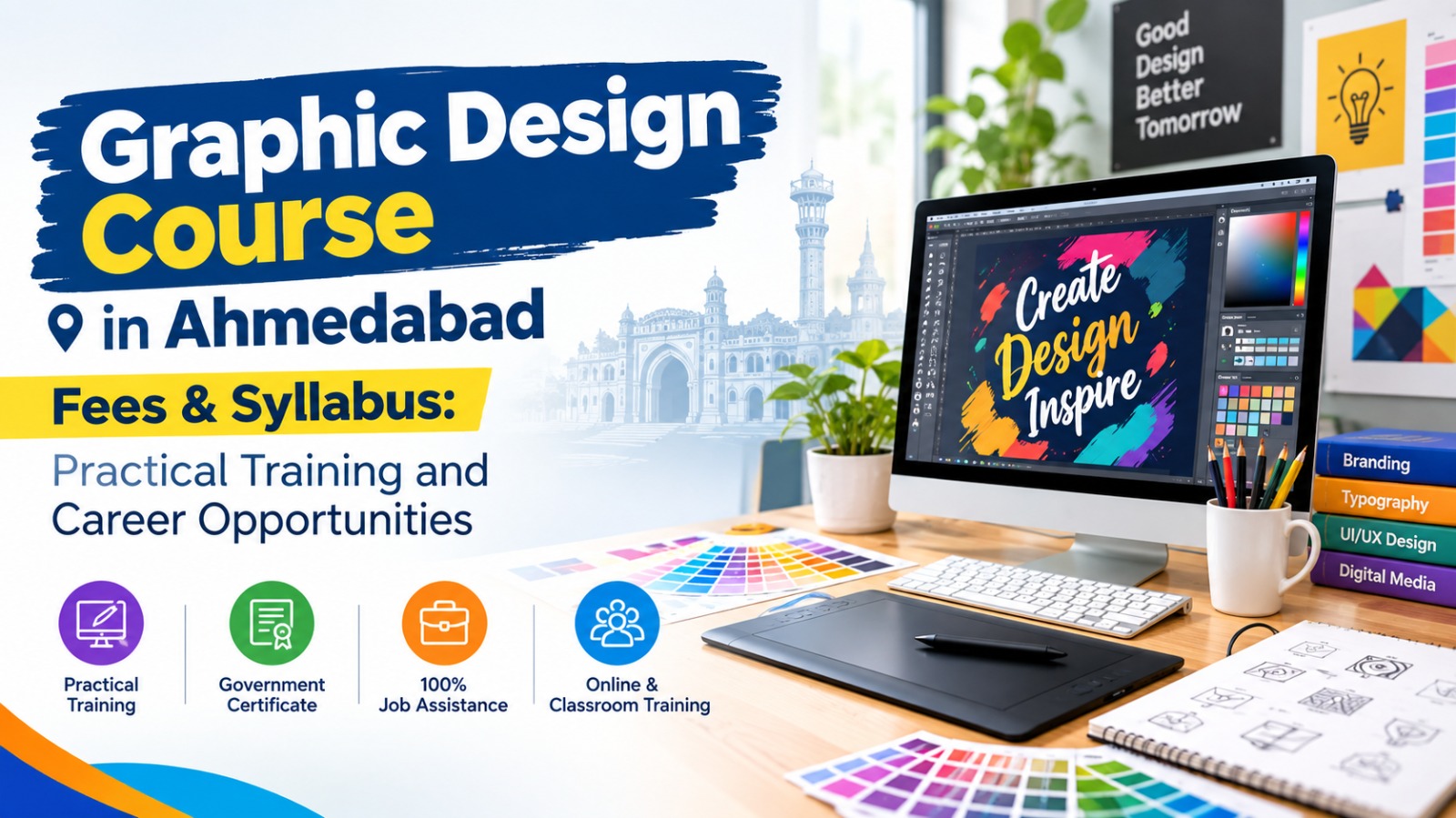
A Graphic Design Course in Ahmedabad can help students, graduates and working professionals develop skills for creating visual content for brands, businesses and digital platforms. A comprehensive course typically covers design fundamentals, colour theory, typography, composition, branding, image editing, digital design and practical projects.
The total course fee can vary depending on duration, syllabus, learning mode, software, practical training, certification and additional career support. Before enrolling, learners should compare the complete course structure rather than focusing only on the advertised fee.
Practical assignments and portfolio development are particularly important because Graphic Design is a skill-based field where employers and clients often want to see examples of actual work.
Introduction
From a company logo and product packaging to social media posts, advertisements and website graphics, visual communication is everywhere.
Behind these designs are Graphic Designers who combine creativity, design principles and digital tools to communicate a message effectively.
For students and professionals interested in a creative career, a Graphic Design Course in Ahmedabad can provide structured training in both design fundamentals and commonly used software.
But before choosing a course, there are several questions to consider:
- What does a Graphic Design course teach?
- How much does it cost in Ahmedabad?
- What software is included?
- Is practical training provided?
- Who can join?
- What career opportunities are available?
This guide covers these questions and explains what learners should look for when choosing a Graphic Design program.
What Is Graphic Design?
Graphic Design is the process of using visual elements to communicate information, ideas or messages.
These visual elements can include:
- Typography
- Colours
- Images
- Illustrations
- Shapes
- Icons
- Layouts
- Patterns
- Visual hierarchy
Graphic Designers use these elements to create visual communication for businesses, organisations, products and digital platforms.
Graphic Design can be used for:
- Branding
- Advertising
- Social media
- Websites
- Packaging
- Publications
- Marketing materials
- Presentations
- Digital campaigns
Why Learn Graphic Design in Ahmedabad?
Ahmedabad has a broad business and creative ecosystem that includes startups, agencies, retailers, educational organisations, technology companies and growing digital businesses.
Businesses across these sectors need visual communication for branding and marketing.
Learning Graphic Design in Ahmedabad can provide students with access to structured training, practical assignments and opportunities to develop a professional portfolio.
For local learners, searching for “Graphic Design classes in Ahmedabad” or “Graphic Design institute near me” can produce many options, so comparing the actual course structure is important.
Graphic Design Course Syllabus in Ahmedabad
The syllabus varies from one institute to another, but a comprehensive Graphic Design course generally starts with design fundamentals and progresses toward practical projects.
1. Design Fundamentals
The foundation of Graphic Design includes:
- Design principles
- Balance
- Contrast
- Alignment
- Proximity
- Repetition
- Visual hierarchy
- Composition
- Grid systems
These principles help designers create organised and visually effective layouts.
2. Colour Theory
Colour plays an important role in visual communication.
Students may learn:
- Primary and secondary colours
- Colour relationships
- Colour harmony
- Contrast
- Colour psychology
- RGB and CMYK
- Digital and print colour considerations
Understanding colour helps designers create appropriate visual identities for different brands and audiences.
3. Typography
Typography involves the selection and arrangement of type.
Students may learn:
- Font families
- Font pairing
- Font hierarchy
- Letter spacing
- Line spacing
- Text alignment
- Readability
- Typography for digital and print designs
Good typography can make information easier to understand and visually consistent.
4. Layout and Composition
Layout determines how visual elements are arranged on a page or screen.
Topics can include:
- Grid systems
- Spacing
- Alignment
- Balance
- Visual flow
- White space
- Hierarchy
These concepts are useful for posters, brochures, websites, social media designs and advertising materials.
5. Logo and Branding Design
Branding is an important part of Graphic Design.
Students may learn how to develop:
- Logo concepts
- Colour palettes
- Typography systems
- Brand guidelines
- Business cards
- Stationery
- Social media branding
- Brand applications
A branding project can become an important part of a student’s portfolio.
6. Image Editing
Image editing is commonly included in Graphic Design courses.
Learners may practise:
- Image correction
- Cropping
- Background removal
- Retouching
- Compositing
- Photo manipulation
- Colour adjustments
- Creative effects
7. Digital and Social Media Design
Modern Graphic Designers often create content for digital platforms.
Students may learn to create:
- Instagram posts
- Social media banners
- Advertisements
- Website banners
- Promotional creatives
- Digital campaigns
- YouTube thumbnails
- Marketing graphics
Designing for digital platforms also requires understanding different dimensions, readability and visual hierarchy.
8. Print Design
Traditional print design may include:
- Brochures
- Flyers
- Posters
- Business cards
- Catalogues
- Magazines
- Packaging
Students can learn about print layouts, resolution, colour modes and preparing files for printing.
Graphic Design Software
A professional Graphic Design course may introduce learners to several software platforms.
| Software | Common Use |
|---|---|
| Adobe Photoshop | Image editing and digital artwork |
| Adobe Illustrator | Vector graphics, logos and illustrations |
| Adobe InDesign | Brochures, magazines and page layouts |
| CorelDRAW | Vector graphics and print design |
| Canva | Quick digital and social media designs |
The exact software taught depends on the institute and course curriculum.
However, software knowledge should be combined with design fundamentals.
Knowing how to use Photoshop is different from knowing how to create an effective visual communication piece.
Graphic Design Course Fees in Ahmedabad
One of the most common questions from students is:
What is the fee for a Graphic Design course in Ahmedabad?
There is no single standard fee because institutes offer different course structures.
Fees may vary based on:
- Course duration
- Number of modules
- Beginner or advanced level
- Classroom or online learning
- Software training
- Practical projects
- Trainer experience
- Certification
- Portfolio development
- Career support
A short-term introductory course will generally have a different fee structure from a comprehensive professional Graphic Design program.
What Should Be Included in the Fee?
Before enrolling, ask whether the fee covers:
- Complete classes
- Practical assignments
- Software training
- Projects
- Portfolio guidance
- Assessments
- Certification
- Study materials
- Career guidance
Comparing these factors gives a clearer picture of the overall value of a course.
Graphic Design Course Duration
Course duration can vary depending on the depth of the curriculum.
A short course may focus on:
- Basic design principles
- Software fundamentals
- Simple projects
A comprehensive course may provide additional training in:
- Branding
- Digital design
- Print design
- Advanced software
- Social media design
- Portfolio development
- Multiple practical projects
When comparing courses, consider the total practical learning time rather than choosing only by the shortest duration.
Practical Graphic Design Training
Graphic Design is a practical skill.
Watching tutorials can introduce learners to software, but practical assignments help them understand how to apply design concepts.
A career-oriented course may include projects such as:
Project 1: Logo Design
Create multiple logo concepts for a fictional or realistic business.
Project 2: Brand Identity
Develop a visual identity including:
- Logo
- Colours
- Typography
- Business card
- Social media applications
Project 3: Social Media Campaign
Design a series of promotional posts using consistent branding.
Project 4: Advertising Design
Create digital or print advertisements for a product or service.
Project 5: Brochure Design
Develop a multi-page brochure with appropriate layout and typography.
These projects can later be selected for a professional portfolio.
Why Portfolio Development Is Important
A portfolio can be more useful than simply listing software on a resume.
It can demonstrate:
- Creativity
- Design fundamentals
- Technical skills
- Problem-solving
- Visual communication
- Consistency
- Ability to work with briefs
A beginner portfolio can include 5–10 well-developed projects rather than a large collection of unfinished designs.
Each project can explain:
- The design brief
- Target audience
- Design approach
- Colour and typography choices
- Final outcome
Graphic Design Course for Beginners
Beginners can start Graphic Design without necessarily having previous professional experience.
A structured beginner-friendly course can follow a progression such as:
Design Basics → Software → Small Assignments → Branding Projects → Digital Design → Portfolio
Students should focus on understanding design principles rather than trying to memorise every tool immediately.
Who Can Join a Graphic Design Course?
Graphic Design courses can be suitable for:
- Students
- Graduates
- Working professionals
- Freelancers
- Entrepreneurs
- Digital marketers
- Content creators
- Social media professionals
- Creative beginners
People from different academic backgrounds can explore Graphic Design if they have an interest in visual communication and are willing to practise.
Graphic Design Course After 10th or 12th
Students who have completed their school education can explore Graphic Design courses depending on the eligibility criteria of the institute.
Learning Graphic Design at an early stage can help students develop:
- Visual thinking
- Design fundamentals
- Digital skills
- Software knowledge
- Portfolio projects
Students should also consider how the course fits into their longer-term education and career plans.
Graphic Design for Working Professionals
Working professionals can use Graphic Design training to expand their existing skill sets.
For example:
A digital marketer can learn to create better campaign creatives.
A content creator can develop stronger visual communication.
A business owner can understand branding and promotional design.
A social media professional can improve the quality and consistency of visual content.
Working professionals may prefer evening, weekend or online classes depending on their schedules.
Career Opportunities After a Graphic Design Course
After developing practical skills and a portfolio, learners can explore roles such as:
- Graphic Designer
- Visual Designer
- Brand Designer
- Creative Designer
- Social Media Designer
- Marketing Designer
- Junior Graphic Designer
- DTP Designer
- Layout Designer
Some professionals also develop freelance careers by offering services such as:
- Logo design
- Branding
- Social media design
- Presentation design
- Advertising creatives
- Brochure design
- Packaging design
Career outcomes depend on practical ability, portfolio quality, communication, experience and market requirements.
Graphic Design vs UI UX Design
Students sometimes find it difficult to decide between Graphic Design and UI UX.
| Graphic Design | UI UX Design |
|---|---|
| Focuses on visual communication | Focuses on digital products and user experience |
| Branding is a major area | User research is a major area |
| Logos, posters and social media | Websites, apps and dashboards |
| Typography and composition | User flows and usability |
| Print and digital design | Mainly digital product experiences |
Both fields share fundamentals such as typography, colour and visual hierarchy.
Is Graphic Design a Good Skill for Freelancing?
Graphic Design can be used for freelance services depending on the designer’s skills and experience.
Freelancers may offer:
- Logo design
- Brand identity
- Social media graphics
- Marketing creatives
- Brochure design
- Presentation design
- Packaging design
A strong portfolio and clear communication are important when working with clients.
How to Choose the Right Graphic Design Institute in Ahmedabad
With many training options available, choosing an institute can be challenging.
Consider these factors before enrolling.
1. Check the Syllabus
Make sure the course covers both design principles and practical software.
2. Ask About Projects
Find out how many practical assignments are included.
3. Review Student Portfolios
If available, look at genuine student work to understand the type of projects learners create.
4. Check Trainer Support
Ask how students receive feedback on assignments.
5. Compare Learning Formats
Choose between classroom, online or hybrid learning according to your requirements.
6. Understand the Fee Structure
Ask what is included in the total course fee.
7. Check Certification
Understand what certificate is provided after completing the program.
8. Ask About Career Assistance
If job assistance is offered, ask whether it includes portfolio reviews, resume guidance, interview preparation or interview opportunities.
Career assistance should not automatically be considered a guarantee of employment.
Benefits of Learning Graphic Design Through Practical Training
A practical course can help learners:
- Apply design principles
- Improve software skills
- Develop creative thinking
- Understand design briefs
- Work with deadlines
- Receive professional feedback
- Build portfolio projects
- Present design concepts
- Develop client communication skills
These skills can be useful in both employment and freelance environments.
The Role of AI in Modern Graphic Design
AI-assisted creative tools are becoming part of many modern design workflows.
Depending on the course, learners may use AI to support:
- Brainstorming
- Concept exploration
- Creative variations
- Image ideation
- Background generation
- Workflow assistance
However, AI should complement rather than replace core design knowledge.
Graphic designers still need to understand:
- Typography
- Colour
- Composition
- Branding
- Visual hierarchy
- Audience
- Creative direction
- Copyright and licensing considerations
Strong design fundamentals remain important even as tools evolve.
Frequently Asked Questions
1. What is the fee for a Graphic Design course in Ahmedabad?
Graphic Design course fees vary depending on course duration, syllabus, software, practical training, learning mode, certification and career support. Compare the complete course structure before enrolling.
2. What is taught in a Graphic Design course?
A comprehensive course can include design fundamentals, colour theory, typography, composition, branding, logo design, image editing, social media design, print design and portfolio development.
3. Which software is used in Graphic Design?
Common software includes Adobe Photoshop, Adobe Illustrator, Adobe InDesign, CorelDRAW and Canva. The exact tools depend on the institute’s syllabus.
4. Can beginners join a Graphic Design course?
Yes. Beginner-level courses can teach design fundamentals and software step by step.
5. Can I learn Graphic Design after 12th?
Depending on the institute’s eligibility requirements, students can explore Graphic Design courses after 12th.
6. Is practical training important in Graphic Design?
Yes. Practical projects help learners apply design concepts, improve software skills and develop a portfolio.
7. How long does a Graphic Design course take?
Duration varies depending on the syllabus and depth of training. Short-term courses may focus on fundamentals, while comprehensive programs can include advanced skills and multiple projects.
8. Can working professionals learn Graphic Design?
Yes. Working professionals can consider online, evening or weekend programs depending on their schedules.
9. Is a Graphic Design certificate enough to get a job?
A certificate demonstrates course completion, but it does not guarantee employment. Employers may also evaluate portfolio quality, practical skills, creativity, communication and experience.
10. Can Graphic Designers work as freelancers?
Yes. Designers can offer services such as branding, logo design, social media graphics, advertising creatives, presentations and other visual communication services depending on their expertise.
Conclusion
A Graphic Design Course in Ahmedabad can provide a structured pathway for students, graduates and working professionals who want to develop creative and digital design skills.
When choosing a course, look beyond the fee and course name. Compare the syllabus, software, practical projects, trainer guidance, portfolio development, course duration, certification and career support.
A strong learning program should help you understand design principles while giving you enough opportunities to practise them through realistic projects.
Graphic Design is a skill-based field, so continuous practice and a strong portfolio can be as important as completing a course.
Whether your goal is to pursue a design job, build freelance services or add creative skills to your existing career, selecting a course that matches your interests and learning goals can provide a useful foundation for your next step.