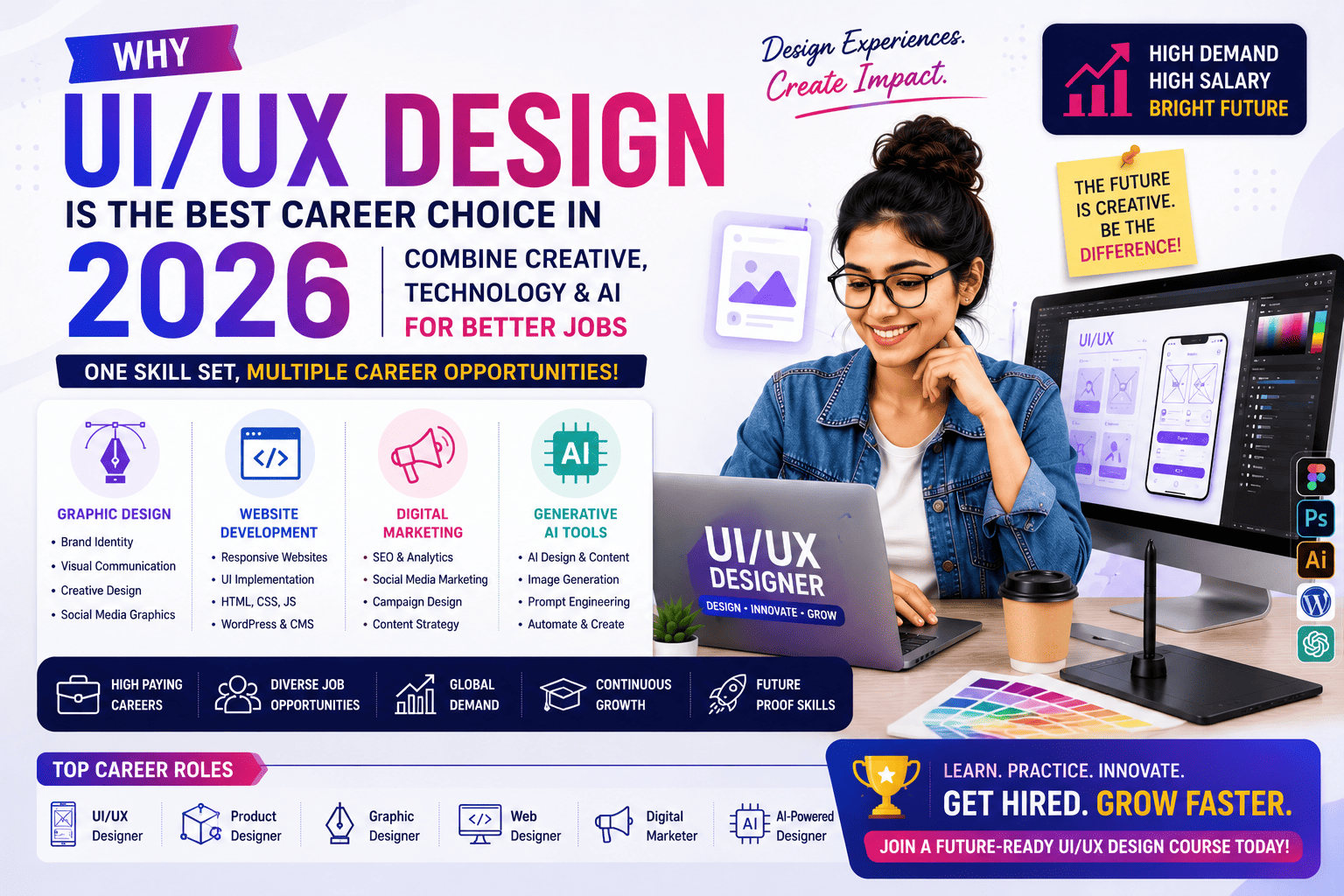
The digital world is changing rapidly, and businesses now need professionals who can do more than create attractive designs. Modern companies seek creative experts who understand User Experience (UX), User Interface (UI), Graphic Design, Digital Marketing, and Generative AI to build engaging digital products and successful marketing campaigns.
In 2026, UI/UX Design has become one of the fastest-growing and most rewarding career paths. When combined with Graphic Design, Website Design, Digital Marketing, and AI-powered tools, it opens doors to high-paying jobs across technology companies, startups, digital agencies, and global organizations.
This comprehensive guide explains why UI/UX Design is the best career choice in 2026, how combining complementary skills creates better career opportunities, and what students and professionals should learn to stay ahead in the creative industry.
Why UI/UX Design Is One of the Fastest-Growing Careers in 2026
Every business today depends on digital platforms to connect with customers. Whether it’s a website, mobile application, e-commerce platform, banking app, or healthcare portal, companies need intuitive and user-friendly interfaces.
UI/UX professionals help organizations:
- Improve customer experience
- Increase website engagement
- Boost mobile app usability
- Reduce customer frustration
- Improve product performance
- Increase conversions
- Strengthen brand trust
As digital products continue to grow, the demand for skilled UI/UX Designers continues to increase worldwide.
What Is UI/UX Design?
UI/UX Design focuses on designing digital experiences that are both visually attractive and easy to use.
UI (User Interface) Design
UI Designers create the visual appearance of digital products.
Responsibilities include:
- Mobile App Design
- Website Interface Design
- Dashboard Design
- Buttons & Components
- Typography
- Icons
- Color Systems
- Responsive Layouts
- Design Systems
UX (User Experience) Design
UX Designers focus on improving user satisfaction through research and testing.
Their work includes:
- User Research
- User Personas
- Customer Journey Mapping
- Information Architecture
- Wireframing
- Interactive Prototypes
- Usability Testing
- Accessibility
Together, UI and UX create digital products that are attractive, functional, and user-friendly.
Why Graphic Design Makes UI/UX Designers Stronger
Graphic Design provides the visual communication skills needed for effective interface design.
Students learn:
- Branding
- Logo Design
- Typography
- Color Theory
- Social Media Creatives
- Marketing Materials
- Packaging Design
- Print Design
- Visual Storytelling
These skills help UI Designers build interfaces that align with a brand’s identity while enhancing user engagement.
Why Digital Marketing Knowledge Gives Designers a Competitive Edge
Modern businesses expect designers to understand how digital products support marketing goals.
Learning Digital Marketing helps UI/UX professionals:
- Design Landing Pages
- Improve Website Conversions
- Create Better User Journeys
- Understand Customer Behavior
- Support SEO-Friendly Design
- Optimize User Engagement
- Improve Campaign Performance
This cross-functional knowledge increases career versatility and collaboration with marketing teams.
The Growing Role of Generative AI in Design
Generative AI is transforming the creative industry by accelerating workflows and improving productivity.
UI/UX Designers use AI to:
- Generate Interface Concepts
- Create Wireframes
- Produce Design Variations
- Write UX Content
- Generate Images
- Analyze User Feedback
- Brainstorm Ideas
- Automate Repetitive Tasks
AI supports creativity by reducing repetitive work, allowing designers to focus on strategy, innovation, and user experience.
Why Employers Prefer Multi-Skilled Professionals
Recruiters increasingly seek candidates who possess multiple complementary skills.
A professional with expertise in:
- UI/UX Design
- Graphic Design
- Digital Marketing
- Website Development
- Generative AI
can contribute to branding, user experience, marketing, and product development, making them valuable across departments.
Skills You Should Learn in 2026
A modern creative professional should develop expertise in the following areas:
UI/UX Design
- Design Thinking
- User Research
- Wireframing
- Prototyping
- Design Systems
- Accessibility
- Usability Testing
Graphic Design
- Branding
- Logo Design
- Typography
- Color Theory
- Layout Design
- Print & Digital Media
Digital Marketing
- SEO Basics
- Content Marketing
- Social Media Marketing
- Email Marketing
- Analytics
- Conversion Optimization
Generative AI
- Prompt Engineering
- AI Design Assistants
- AI Image Generation
- AI Content Creation
- Workflow Automation
Essential Software to Learn
Professional designers should gain practical experience with:
- Figma
- Adobe Photoshop
- Adobe Illustrator
- Adobe XD
- FigJam
- Canva
- WordPress
- Google Analytics
- Google Search Console
- AI Design Platforms
Hands-on software training improves employability and portfolio quality.
Practical Learning Builds Job-Ready Skills
Theory alone is not enough to succeed in the creative industry.
Students should gain experience through:
- Live Projects
- Real Client Assignments
- Website Design
- Mobile App Design
- Branding Projects
- UX Case Studies
- Portfolio Development
- Collaborative Team Projects
Employers value candidates who can demonstrate practical problem-solving abilities.
Career Opportunities After Learning These Skills
Graduates can pursue roles such as:
- UI Designer
- UX Designer
- Product Designer
- Graphic Designer
- Digital Marketing Designer
- Creative Designer
- Visual Designer
- Web Designer
- UX Researcher
- Brand Designer
- Marketing Creative
- Freelance Designer
These roles are available across startups, IT companies, digital agencies, product companies, and multinational organizations.
Salary Expectations in India (2026)
Actual salaries depend on experience, skills, portfolio quality, employer, and location.
| Experience | Approximate Annual Salary |
|---|---|
| Fresher | ₹3–6 LPA |
| 1–3 Years | ₹6–10 LPA |
| 3–5 Years | ₹10–18 LPA |
| Senior Professionals | ₹18 LPA+ |
Professionals with expertise in UI/UX Design, Graphic Design, Digital Marketing, and AI-assisted workflows often have access to broader career opportunities.
Why Ahmedabad Is an Excellent Place to Learn UI/UX Design
Ahmedabad has become a rapidly growing center for:
- Software Development
- Product Companies
- Startups
- Digital Marketing Agencies
- Branding Studios
- IT Services
- E-commerce Businesses
Students benefit from internship opportunities, industry exposure, networking events, and a growing creative ecosystem.
Who Should Choose This Career?
UI/UX Design is suitable for:
- Students after Class 10 or 12
- College Students
- Graduates
- Working Professionals
- Career Changers
- Graphic Designers
- Digital Marketers
- Entrepreneurs
- Freelancers
- Website Designers
No programming background is required for beginner-level UI/UX courses.
How to Choose the Best UI/UX Design Course
Look for an institute that offers:
✅ Industry-Relevant Curriculum
✅ Graphic Design Integration
✅ Digital Marketing Fundamentals
✅ Generative AI Training
✅ Live Industry Projects
✅ Portfolio Development
✅ Internship Opportunities
✅ Government-Recognised Certification
✅ Placement Assistance
Choose a programme that emphasizes practical learning and career readiness.
Frequently Asked Questions (FAQs)
1. Why is UI/UX Design considered one of the best careers in 2026?
UI/UX Design is in high demand because businesses rely on websites, mobile apps, and digital platforms to engage customers. Skilled designers help improve user experience, increase customer satisfaction, and support business growth.
2. Should I learn Graphic Design with UI/UX Design?
Yes. Graphic Design strengthens your understanding of branding, typography, layout, and visual communication, making you a more versatile UI Designer.
3. Why should UI/UX Designers learn Digital Marketing?
Digital Marketing helps designers understand customer behavior, landing page optimization, SEO-friendly layouts, and conversion-focused user journeys.
4. How does Generative AI help UI/UX Designers?
Generative AI supports idea generation, wireframing, content creation, design variations, and workflow automation, allowing designers to work more efficiently.
5. Do I need coding to become a UI/UX Designer?
No. Most beginner-level UI/UX Design courses focus on research, design, prototyping, and user experience. Basic knowledge of HTML and CSS can be beneficial but is not mandatory.
6. What software should I learn?
Industry-standard tools include Figma, Adobe Photoshop, Illustrator, Adobe XD, FigJam, Canva, Google Analytics, and AI-powered design platforms.
7. Can I work as a freelancer after completing a UI/UX course?
Yes. Many UI/UX Designers successfully work as freelancers, providing services such as website design, app design, branding, user research, and design consulting.
8. Does a government certificate guarantee a job?
A government-recognized certificate strengthens your profile, but employers also evaluate your practical skills, portfolio, communication abilities, and problem-solving approach.
Conclusion
In 2026, UI/UX Design stands out as one of the most future-ready creative careers because it combines creativity, technology, and user-centered problem-solving. When paired with Graphic Design, Digital Marketing, and Generative AI, professionals develop a versatile skill set that aligns with the evolving needs of businesses across industries.
Choosing a course that emphasizes 100% practical learning, live projects, portfolio development, government-recognized certification, internship opportunities, and placement support can help students and working professionals build strong foundations for long-term success. By continuously upgrading skills and embracing new technologies, aspiring designers can unlock rewarding opportunities in product design, branding, marketing, and digital innovation.